Post provided by Narimane Chatar (She/Her) Romain Boman (He/Him), Valentin Fallon Gaudichon (He/Him), Jamie A. MacLaren (He/Him), Valentin Fischer (He/Him).
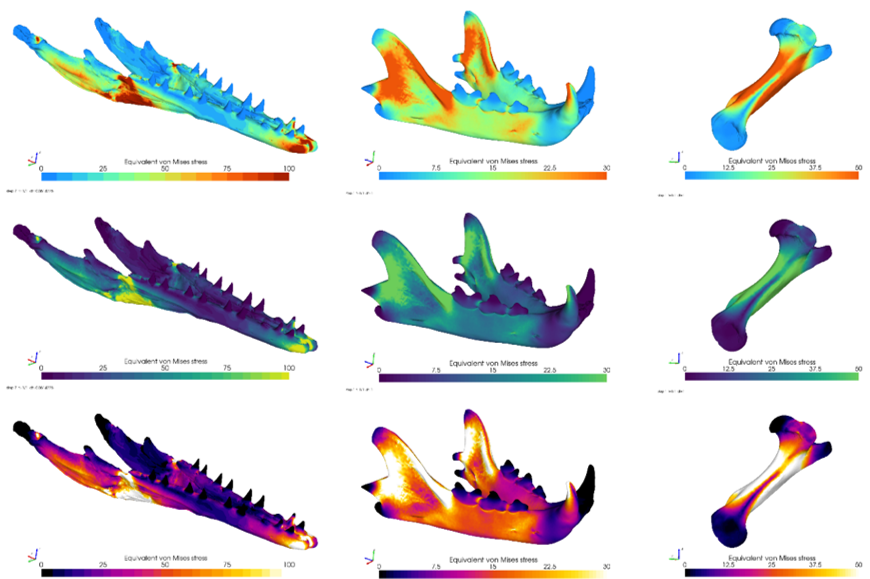
Understanding the way that bones and other biological materials deal with the stresses and strains of everyday life is fundamental for interpreting the behaviour of modern and extinct organisms. Researchers frequently do this by using a digital simulation which can predict the behaviour of materials by breaking complex objects down into much smaller elements – this is known as finite element modelling. In this blog post, Narimane Chatar and her co-authors discuss their new protocol for performing finite element modelling aimed at life-sciences and biomechanics which is fast, open-source, and free for all to use.
Fóssil de caranguejo-ferradura (Museu de História Natural de Berlin)
Há alguns dias, me deparei com um interessante vídeo sobre os chamados “fósseis vivos”. O vídeo focou mais nos problemas de usá-los como argumentos contra a teoria da evolução, e aproveitei a oportunidade para falar mais sobre essas linhagens longevas.
‘Fóssil vivo‘ é um termo usado para descrever linhagens que acredita-se terem se originado há muito tempo e que mantêm características que se assemelham a seus parentes fósseis. Alguns exemplos bem conhecidos dessas linhagens são os Tuatara da Nova Zelândia (Sphenodon punctatus) e as árvores Gingkos (Gingko biloba).
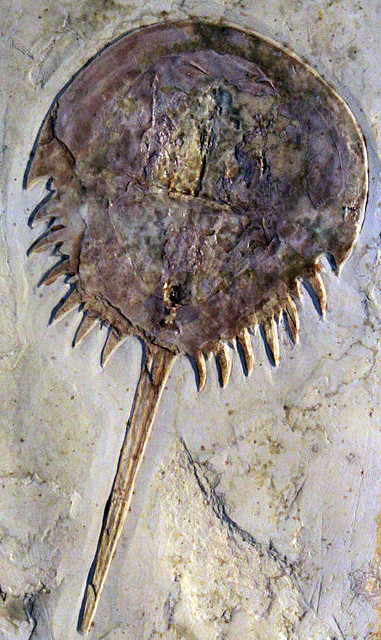
Fossil of a Horseshoe crab (Museum of Natural History Berlin)
A couple of days ago I came across a nice video (in Portuguese only, sorry) about so-called “living fossils”. The video focused on the problems of using them as arguments against evolution. But I’d like to take the opportunity to talk more about these long-lived lineages.
‘Living fossil’ is a term used to describe lineages that are thought to have been around for a very long time and retain characteristics that resemble of their fossil relatives. A couple of well-known examples of these lineages are the Tuatara of New Zealand (Sphenodon punctatus) and the Gingko tree (Gingko biloba).
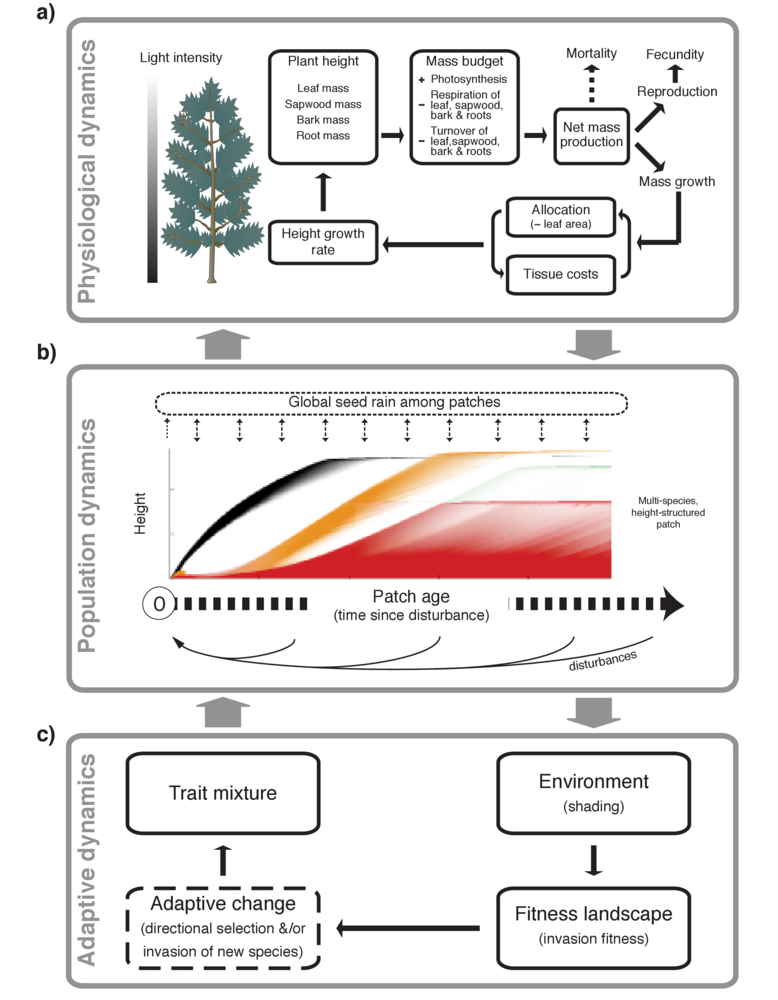
Our paper in Methods in Ecology and Evolution describes a new software package, plant. plant is an individual-based simulation model that simulates the growth of individual trees, stands of competing plants, or entire metacommunities under a disturbance regime, using common physiological rules and trait-based functional trade-offs to capture differences among species.
Non-Linear Processes and Thousands of Plants
Since the development of gap models in the 1970s (e.g. Botkin 1972), researchers have been using computer simulations to investigate how elements of plant biology interact with competition and disturbance regimes to influence vegetation demography, structure and diversity. Simulating the competitive interactions among many thousands of plants, however, is no easy task.
Despite widespread recognition of the importance of key non-linear processes — such as size-structured competition, disturbance, and trait-based trade-offs — for vegetation dynamics, relatively few researchers have been brave (or daft) enough to try and incorporate such processes into their models. The situation is most extreme in theoretical ecology, where much contemporary theory (e.g. coexistence theory, neutral theory) is still built around completely unstructured populations.
Features of plant
Key processes modelled within the plant package.
The plant package attempts to change that by providing an extensible, open source framework for studying trait-, size- and patch-structured dynamics. One thing that makes the plant model significant is the focus on traits. plant is one of several attempts seeking to integrate current understanding about trait based trade-offs into a model of individual plant function (see also Moorcroft et al 2001, Sakschewski et al 2015).
A second feature that makes the plant software significant, is it that is perhaps the first example where a computationally intensive model has been packaged up in a way that enables widespread usage, makes the model more usable and doesn’t sacrifice speed.



 Methods Blog