Demography and Big Data

Post provided by BRITTANY TELLER, KRISTIN HULVEY and ELISE GORNISH

Follow Brittany (@BRITTZINATOR) and Elise (@RESTORECAL) on Twitter

To understand how species survive in nature, demographers pair field-collected life history data on survival, growth and reproduction with statistical inference. Demographic approaches have significantly contributed to our understanding of population biology, invasive species dynamics, community ecology, evolutionary biology and much more.

As ecologists begin to ask questions about demography at broader spatial and temporal scales and collect data at higher resolutions, demographic analyses and new statistical methods are likely to shed even more light on important ecological mechanisms.

Population Processes

Midsummer Opuntia cactus in eastern Idaho, USA. © B. Teller.

Traditionally, demographers collect life history data on species in the field under one or more environmental conditions. This approach has significantly improved our understanding of basic biological processes. For example, rosette size is a significant predictor of survival for plants like wild teasel (Werner 1975 – links to all articles are at the end of the post), and desert annual plants hedge their bets against poor years by optimizing germination strategies (Gremer & Venable 2014).

Demographers also include temporal and spatial variability in their models to help make realistic predictions of population dynamics. We now know that temporal variability in carrying capacity dramatically improves population growth rates for perennial grasses and provides a better fit to data than models with varying growth rates because of this (Fowler & Pease 2010). Moreover, spatial heterogeneity and environmental stochasticity have similar consequences for plant populations (Crone 2016). Continue reading “Demography and Big Data”

Inverse Modelling and IPMs: Estimating Processes from Incomplete Information

Post provided by Edgar J. González

In demography, a set of processes (survival, growth, fecundity, etc.) interacts to produce observable patterns (population size, structure, growth rate, etc.) that change over time. With traditional approaches you follow the individuals of a population over some timespan and track all of these processes.

Demographic patterns and processes (Click to expand)

However, depending on the organism, some processes may be very hard to quantify (e.g. mortality or recruitment in animals or plants with long lifespans). You may have observed the patterns for the organism that you’re studying and, even better, measured some, but not all, of the processes. The question is: can we use this limited information to estimate the processes we couldn’t measure? Continue reading “Inverse Modelling and IPMs: Estimating Processes from Incomplete Information”

How Did We Get Here From There? A Brief History of Evolving Integral Projection Models

Post provided by MARK REES and Steve Ellner

The Early Days: Illyrian Thistle and IBMs

Illyrian Thistle
Illyrian Thistle

Back in 1997 MR was awarded a travel grant from CSIRO to visit Andy Sheppard in Canberra. CSIRO had been collecting detailed long-term demographic data on several plant species and Andy was keen to develop data-driven models for management.

Andy decided Illyrian thistle (Onopordum Illyricum) would be a good place to start, as this was the most complicated in terms of its demography. The field study provided information on size, age and seed production. The initial goal was to quantify the impact of seed feeders on plant abundance, but after a few weeks of data analysis it became apparent that the annual seed production per quadrat was huge (in the 1000s) but there were always ~20 or so recruits. This meant that effects of seed feeders (if any) occurred outside the range of the data, which wasn’t ideal for quantitative prediction.

So the project developed in a different direction. Onopordum is a monocarpic perennial (it lives for several years then flowers and dies) and Tom de Jong and Peter Klinkhamer had recently developed models to predict at what size or age monocarps should flower, so it seemed reasonable to see if this would work. Continue reading “How Did We Get Here From There? A Brief History of Evolving Integral Projection Models”

Key Technologies Used to Build the plant Package (and Maybe Soon Some Other Big Simulation Models in R)

Post provided by RICH FITZJOHN and DANIEL FALSTER

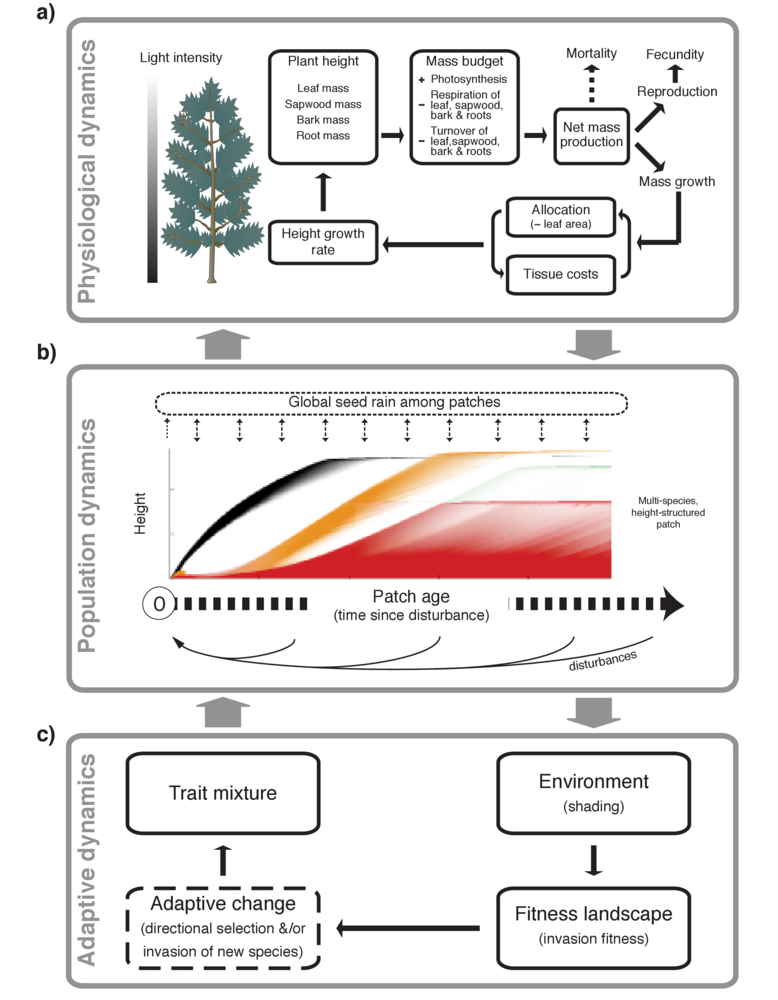
Our paper in Methods in Ecology and Evolution describes a new software package, plantplant is an individual-based simulation model that simulates the growth of individual trees, stands of competing plants, or entire metacommunities under a disturbance regime, using common physiological rules and trait-based functional trade-offs to capture differences among species.

Non-Linear Processes and Thousands of Plants

Since the development of gap models in the 1970s (e.g. Botkin 1972), researchers have been using computer simulations to investigate how elements of plant biology interact with competition and disturbance regimes to influence vegetation demography, structure and diversity. Simulating the competitive interactions among many thousands of plants, however, is no easy task.

Despite widespread recognition of the importance of key non-linear processes — such as size-structured competition, disturbance, and trait-based trade-offs — for vegetation dynamics, relatively few researchers have been brave (or daft) enough to try and incorporate such processes into their models. The situation is most extreme in theoretical ecology, where much contemporary theory (e.g. coexistence theory, neutral theory) is still built around completely unstructured populations.

Features of plant

Key processes modelled within the plant package.

The plant package attempts to change that by providing an extensible, open source framework for studying trait-, size- and patch-structured dynamics. One thing that makes the plant model significant is the focus on traits. plant is one of several attempts seeking to integrate current understanding about trait based trade-offs into a model of individual plant function (see also Moorcroft et al 2001Sakschewski et al 2015).

A second feature that makes the plant software significant, is it that is perhaps the first example where a computationally intensive model has been packaged up in a way that enables widespread usage, makes the model more usable and doesn’t  sacrifice speed.

In this post we will describe the key technologies used to build the plant software. Continue reading “Key Technologies Used to Build the plant Package (and Maybe Soon Some Other Big Simulation Models in R)”

Demography Beyond the Population Webinar: Register for Free Now

Webinar logoRegister for FREE for the first ever BES Publishing webinar based on our forthcoming Demography Beyond the Population Special Feature.

This hour long webinar will begin at 1pm (GMT) on Tuesday 1 March. It highlights some of the excellent articles soon to be published in the British Ecological Society journals Special Feature entitled “Demography Beyond the Population”. The Special Feature is a collaborative effort including articles in all six BES journals. This is the first time such a large ecological collaboration has been attempted worldwide. Using a cross-journal approach has allowed us to highlight the strongly interdisciplinary nature of the field of demography to its fullest potential as well as to lay down the foundations for future directions at the interface of ecology, evolution, conservation biology and human welfare. The webinar has several international speakers and will discuss the articles in the Special Feature and the implications for demography research going forward. Continue reading “Demography Beyond the Population Webinar: Register for Free Now”

Issue 7.1

Issue 7.1 is now online!

The January issue of Methods is now online!

As always, the first issue of the year is our sample issue. You can access all of the articles online free of charge. No subscription or membership is required!

We have two Open Access articles and two Applications papers in our January issue.

Recognizing False Positives: Environmental DNA (eDNA) is increasingly used for surveillance and detection of species of interest in aquatic and soil samples. A significant risk associated with eDNA methods is potential false-positive results due to laboratory contamination. To minimize and quantify this risk, Chris Wilson et al. designed and validated a set of synthetic oligonucleotides for use as species-specific positive PCR controls for several high-profile aquatic invasive species.

BiMat: An open-source MATLAB package for the study of the structure of bipartite ecological networks. BiMat enables both multiscale analysis of the structure of a bipartite ecological network – spanning global (i.e. entire network) to local (i.e. module-level) scales – and meta-analyses of many bipartite networks simultaneously. The authors have chosen to make this Applications article Open Access.

Gemma Murray et al. provide this month’s second Open Access article. In ‘The effect of genetic structure on molecular dating and tests for temporal signal‘ the authors use simulated data to investigate the performance of several tests of temporal signal, including some recently suggested modifications. The article shows that all of the standard tests of temporal signal are seriously misleading for data where temporal and genetic structures are confounded (i.e. where closely related sequences are more likely to have been sampled at similar times). This is not an artifact of genetic structure or tree shape per se, and can arise even when sequences have measurably evolved during the sampling period.

Our January issue also features articles on Monitoring, Population Ecology, Genetics, Evolution, Community Ecology, Diversity and more. Continue reading “Issue 7.1”

Introducing Biodiverse: Phylodiversity Made Easy

Post provided by SHAWN LAFFAN and ANDREW THORNHILL

© Shawn Laffan
© Shawn Laffan

Phylodiversity indices are increasingly used in spatial analyses of biodiversity, driven largely by the increased availability of phylogenetic trees and the tools to analyse them. Such analyses are integral to understanding evolutionary history and deciding where to allocate conservation resources.

Phylogenetic Indices: The Current Favourites

The most commonly used phylogenetic index is Faith’s Phylogenetic Diversity (PD; Faith 1992). PD is the phylogenetic analogue of taxon richness and is expressed as the number of tree units which are found in a sample.

More recently developed phylodiversity indices adapt the calculation of PD by adjusting the branch lengths of a sample using the local lineage range sizes and abundances, for example Phylogenetic Endemism (PE) and Abundance weighted Evolutionary Diversity (AEDt). In PE the length of each branch in a sample is multiplied by the fraction of its total geographic range found in that sample. The AEDt index uses the same general approach, but weights each branch by the fraction of total abundances found in the sample. The weighting process is generic, so one can scale the branch lengths by any relevant factor, for example the threat status (Faith 2015). Continue reading “Introducing Biodiverse: Phylodiversity Made Easy”

Methods in Ecology and Evolution 2015: The Year in Review

Happy New Year! We hope that you all had a wonderful Winter Break and that you’re ready to start 2016. We’re beginning the year with a look back at some of our highlights of 2015. Here’s how last year looked at Methods in Ecology and Evolution.

The Articles

We published some amazing articles in 2015, too many to mention them all here. However, we would like to say a massive thank you to all of the authors, reviewers and editors who contributed to the journal last year. Without your hard work, knowledge and generosity, the journal would not be where it is today. We really appreciate all of your time and effort. THANK YOU!

mee312268_CoverOpportunities at the Interface between Ecology and Statistics

There was only one Special Feature in the journal this year, but it was a great one. Arising from the 2013 Eco-Stats Symposium at the University of New South Wales and guest edited by Associate Editor David Warton, Opportunities at the Interface between Ecology and Statistics was one of the highlights of 2015 for us. It consists of seven articles written collaboratively by statisticians and ecologists and highlights the benefits of cross-disciplinary partnerships. Continue reading “Methods in Ecology and Evolution 2015: The Year in Review”

Measuring Survival Selection in Natural Populations: How important is recapture probability?

Post Provided by John Waller

The “Lande-Arnold” Approach

Damselflies marked in the field, which will hopefully be recaptured later. This small insect at our field site had only about 10% recapture probability.

The quantification of survival selection in the field has a long history in evolutionary biology. A considerable milestone in this field was the highly influential publication by Russel Lande and Steve Arnold in the early 1980s.

The practical implementation of Lande and Arnold’s method involved simply fitting a linear model with standardized response (survival) and explanatory (trait) variables values with quadratic terms (multiplied by two). This straightforward method allowed evolutionary biologists to measure selection coefficients using commonly available statistical software and these estimates could be used directly within a quantitative genetic framework.  Continue reading “Measuring Survival Selection in Natural Populations: How important is recapture probability?”

Maximising the Exposure of Your Research: Search Engine Optimisation and why it matters

This post is an outcome of the ‘Maximising the Exposure of Your Research’ Workshop at the BES 2015 Annual Meeting in Edinburgh (UK). If you’re interested in joining us for our 2016 Annual Meeting in Liverpool (UK), you can find some more information and pre-register HERE.

© Got Credit
© Got Credit

In recent years there has been a significant increase in the number of academic articles published. At the same time, readers are changing how they find content, tending towards a point of entry at article level as opposed to journal level. These two factors mean that it is increasingly necessary for authors to make their articles easy for relevant readers to find. Search Engine Optimisation (SEO) is one of the best ways to do this.

While writing your paper, there are a few things that you can do to optimise it for search engines, such as Google Scholar. The tips below focus on three areas that are prioritised by search engines when looking for content. Following these tips will help you to maximise the exposure of your research. Continue reading “Maximising the Exposure of Your Research: Search Engine Optimisation and why it matters”