Ten Years of Methods in Ecology and Evolution

Methods in Ecology and Evolution is turning 10 years old! Back in 2010, we launched the journal because of feedback from the community that there was a need for a journal that promoted the publication of new methods. Founding Editor Rob Freckleton and Graziella Iossa (now a member of the Editorial Board) summarised the aims and ambitions for the journal in the first issue. They … Continue reading Ten Years of Methods in Ecology and Evolution

Two More New Associate Editors

Today we are welcoming two more Associate Editors to the Methods in Ecology and Evolution who were invited to work with the journal following our open call earlier this year. Jessica Royles joins from the University of Cambridge, UK and Simon Blomberg is coming to us from the University of Queensland, Australia. You can find out more about both of them below. Simon Blomberg “I am a statistician who started out … Continue reading Two More New Associate Editors

Issue 7.12

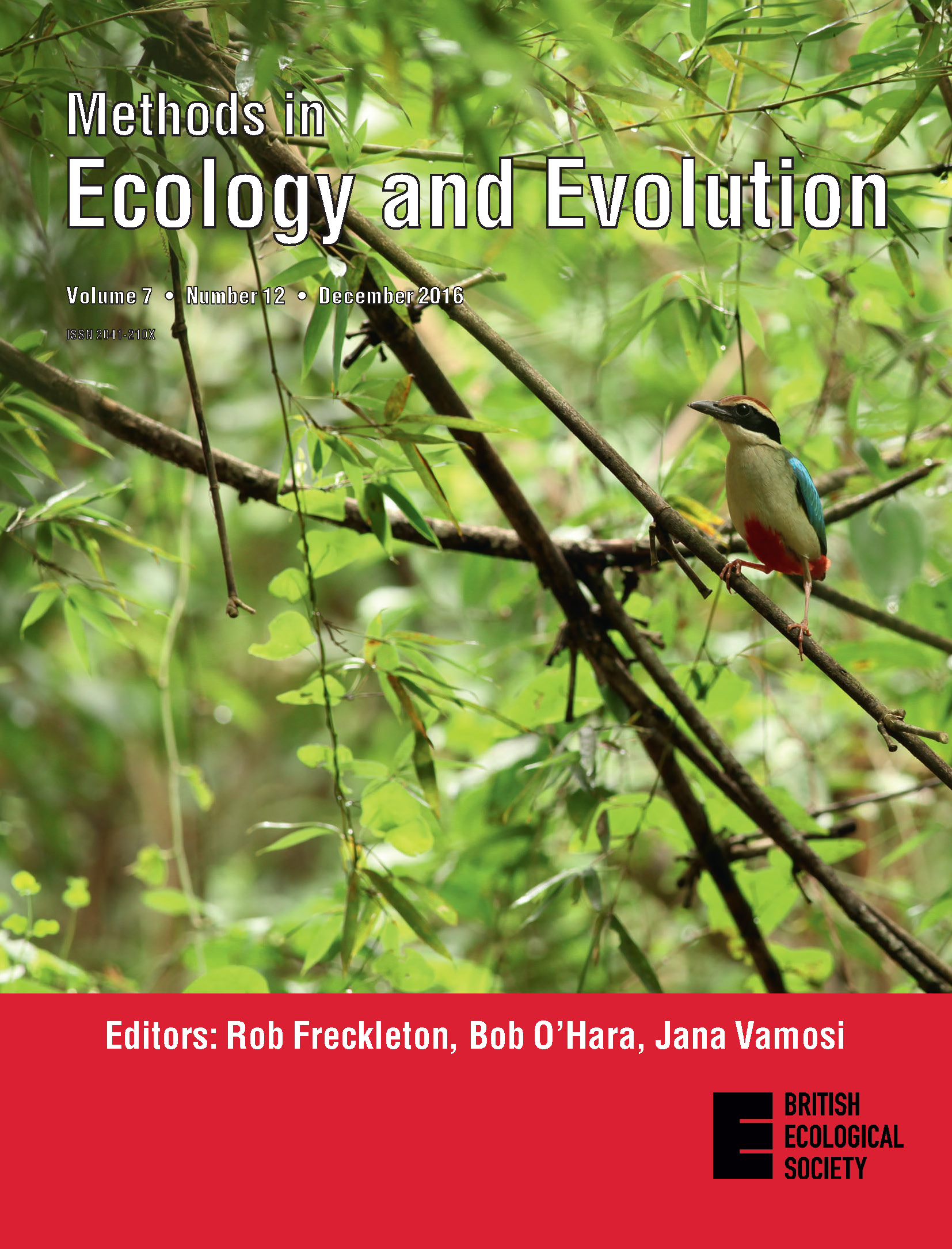
Issue 7.12 is now online!

The final 2016 issue of Methods is now online!

This month’s issue contains four Applications articles and two Open Access articles, all of which are freely available.

– iNEXT: The R package iNEXT (iNterpolation/EXTrapolation) provides simple functions to compute and plot the seamless rarefaction and extrapolation sampling curves for the three most widely used members of the Hill number family (species richness, Shannon diversity and Simpson diversity).

– camtrapR: A new toolbox for flexible and efficient management of data generated in camera trap-based wildlife studies. The package implements a complete workflow for processing camera trapping data.

– rotl: An R package to search and download data from the Open Tree of Life directly in R. It uses common data structures allowing researchers to take advantage of the rich set of tools and methods that are available in R to manipulate, analyse and visualize phylogenies.

– Fluctuating-temperature chamber: A design for economical, programmable fluctuating-temperature chambers based on a relatively small commercially manufactured constant temperature chamber modified with a customized, user-friendly microcontroller.

Continue reading “Issue 7.12”

What is Methods in Ecology and Evolution?

In a new Methods in Ecology and Evolution podcast, the Senior Editors – Rob Freckleton, Bob O’Hara and Jana Vamosi – discuss the past, present and future of the journal. They talk about what sets it apart from other journals, their favourite articles and the kinds of papers that they would like to see more of. If you’re thinking about submitting to Methods in Ecology and … Continue reading What is Methods in Ecology and Evolution?

Demography and Big Data

Post provided by BRITTANY TELLER, KRISTIN HULVEY and ELISE GORNISH

Follow Brittany (@BRITTZINATOR) and Elise (@RESTORECAL) on Twitter

To understand how species survive in nature, demographers pair field-collected life history data on survival, growth and reproduction with statistical inference. Demographic approaches have significantly contributed to our understanding of population biology, invasive species dynamics, community ecology, evolutionary biology and much more.

As ecologists begin to ask questions about demography at broader spatial and temporal scales and collect data at higher resolutions, demographic analyses and new statistical methods are likely to shed even more light on important ecological mechanisms.

Population Processes

Midsummer Opuntia cactus in eastern Idaho, USA. © B. Teller.

Traditionally, demographers collect life history data on species in the field under one or more environmental conditions. This approach has significantly improved our understanding of basic biological processes. For example, rosette size is a significant predictor of survival for plants like wild teasel (Werner 1975 – links to all articles are at the end of the post), and desert annual plants hedge their bets against poor years by optimizing germination strategies (Gremer & Venable 2014).

Demographers also include temporal and spatial variability in their models to help make realistic predictions of population dynamics. We now know that temporal variability in carrying capacity dramatically improves population growth rates for perennial grasses and provides a better fit to data than models with varying growth rates because of this (Fowler & Pease 2010). Moreover, spatial heterogeneity and environmental stochasticity have similar consequences for plant populations (Crone 2016). Continue reading “Demography and Big Data”

Measuring Survival Selection in Natural Populations: How important is recapture probability?

Post Provided by John Waller

The “Lande-Arnold” Approach

Damselflies marked in the field, which will hopefully be recaptured later. This small insect at our field site had only about 10% recapture probability.

The quantification of survival selection in the field has a long history in evolutionary biology. A considerable milestone in this field was the highly influential publication by Russel Lande and Steve Arnold in the early 1980s.

The practical implementation of Lande and Arnold’s method involved simply fitting a linear model with standardized response (survival) and explanatory (trait) variables values with quadratic terms (multiplied by two). This straightforward method allowed evolutionary biologists to measure selection coefficients using commonly available statistical software and these estimates could be used directly within a quantitative genetic framework.  Continue reading “Measuring Survival Selection in Natural Populations: How important is recapture probability?”

The Methods in Ecology and Evolution 5th Anniversary Impact Factor

Thomson-Reuters have just released this year’s Impact Factors. The Methods in Ecology and Evolution Impact Factor is now an astounding 6.554, up from a truly dismal 5.322 last year. We now have enough years of Impact Factors to make it worthwhile drawing a graph.

Zoooom!
The Methods in Ecology and Evolution Impact Factor goes up and up (…except when it doesn’t).

This puts us ninth in Ecology, and we would be fifth in Evolutionary Biology if Thomson-Reuters thought we published stuff in Evolutionary Biology. We would also be top in Statistics and Substance Abuse if we could get ourselves into either of those categories. Continue reading “The Methods in Ecology and Evolution 5th Anniversary Impact Factor”