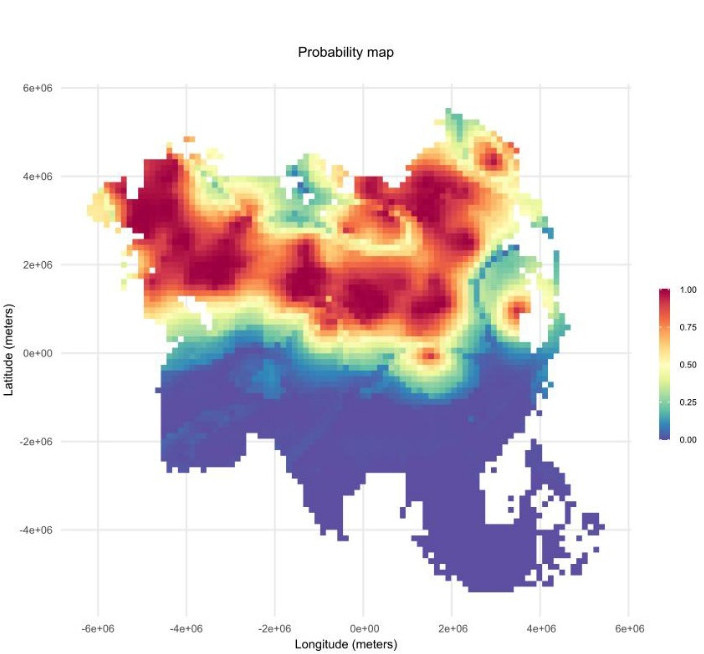
A very important ecological feature of a species is its geographic range, which can be described by its size, position and shape. Studying the geographic range can be useful to understand the ecological needs of a species and, thereby, to plan conservation strategies. In ecological studies, mathematical models are the new standard to reconstruct the distribution of living species on Earth because of their accuracy in predicting a species presence or absence at unsampled locations. These methods are able to reconstruct the climatic niche of a species and to project it onto a geographic domain in order to predict the species’ spatial distribution. To do this, besides the occurrences of a species, the models necessarily require the spatial maps of environmental variables, like temperature and precipitation, for all the study area.
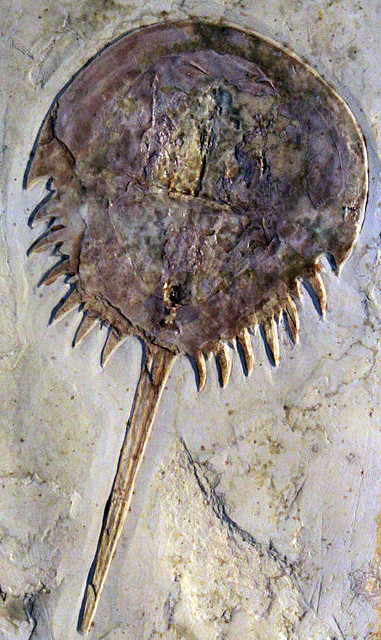
Fóssil de caranguejo-ferradura (Museu de História Natural de Berlin)
Há alguns dias, me deparei com um interessante vídeo sobre os chamados “fósseis vivos”. O vídeo focou mais nos problemas de usá-los como argumentos contra a teoria da evolução, e aproveitei a oportunidade para falar mais sobre essas linhagens longevas.
‘Fóssil vivo‘ é um termo usado para descrever linhagens que acredita-se terem se originado há muito tempo e que mantêm características que se assemelham a seus parentes fósseis. Alguns exemplos bem conhecidos dessas linhagens são os Tuatara da Nova Zelândia (Sphenodon punctatus) e as árvores Gingkos (Gingko biloba).
Fossil of a Horseshoe crab (Museum of Natural History Berlin)
A couple of days ago I came across a nice video (in Portuguese only, sorry) about so-called “living fossils”. The video focused on the problems of using them as arguments against evolution. But I’d like to take the opportunity to talk more about these long-lived lineages.
‘Living fossil’ is a term used to describe lineages that are thought to have been around for a very long time and retain characteristics that resemble of their fossil relatives. A couple of well-known examples of these lineages are the Tuatara of New Zealand (Sphenodon punctatus) and the Gingko tree (Gingko biloba).
The source of occurrence data: fossil collections (photo by Konstantin Frisch).
To find out about changes in ancient ecosystems we need to analyse fossil databases that register the taxonomy and stratigraphic (temporal) positions of fossils. These data can be used to detect changes of taxonomic diversity and to draft time series of originations and extinctions.
The story would be so simple if it wasn’t the effects of heterogeneous and incomplete sampling: the white spots in our understanding of where and when species lived exactly. This phenomenon decreases the fidelity of face-value patterns extracted from the fossil record, making them less reliable. It must be considered if we want to get a glimpse into the biology or the distribution of life in space and time. Naturally, several metrics have been proposed to overcome this problem, each claiming to accurately depict the patterns of ancient life. Continue reading “Revisiting Past Biodiversity with the divDyn R Package”
I had the pleasure of delivering one of the plenary talks at the first (hopefully of many) Crossing the Palaeontological – Ecological Gap meeting held in the University of Leeds on August 30th and 31st. I’m a geologist and a botanist, so this is a topic that’s close to my heart and my professional interests.
As we move into an ecologically uncertain future with pressures of climate change, land-use change and resource limitations, the fossil record offers the only truly long-term record of how Earth’s ecosystems respond to major environmental upheaval driven by climate change events. The fossil record is, of course, not without its problems – there are gaps, not everything fossilises in the same way or numbers, and comparisons to today’s ecology are extremely difficult. It’s these difficulties (and other challenges) that make the uniting of palaeontology and ecology essential to fully address how plants, animals and other organisms have responded to major changes in the past. Perhaps uniting them could give us an idea of what to expect in our near-term future, as carbon dioxide levels return to those not previously experienced on Earth since the Pliocene, over 2 million years ago. Continue reading “What the Past Can Tell Us About the Future: Notes from Crossing the Palaeontological – Ecological Gap”
Today is the first day of the Crossing the Palaeontological-Ecological Gap (CPEG) conference. The aim of the conference is to open a dialogue between palaeontologists and ecologists who work on similar questions but across vastly different timescales. This splitting of temporal scales tends to make communication, data integration and synthesis in ecology harder. A lot of this comes from the fact that palaeontologists and ecologists tend to publish in different journals and attend different meetings.
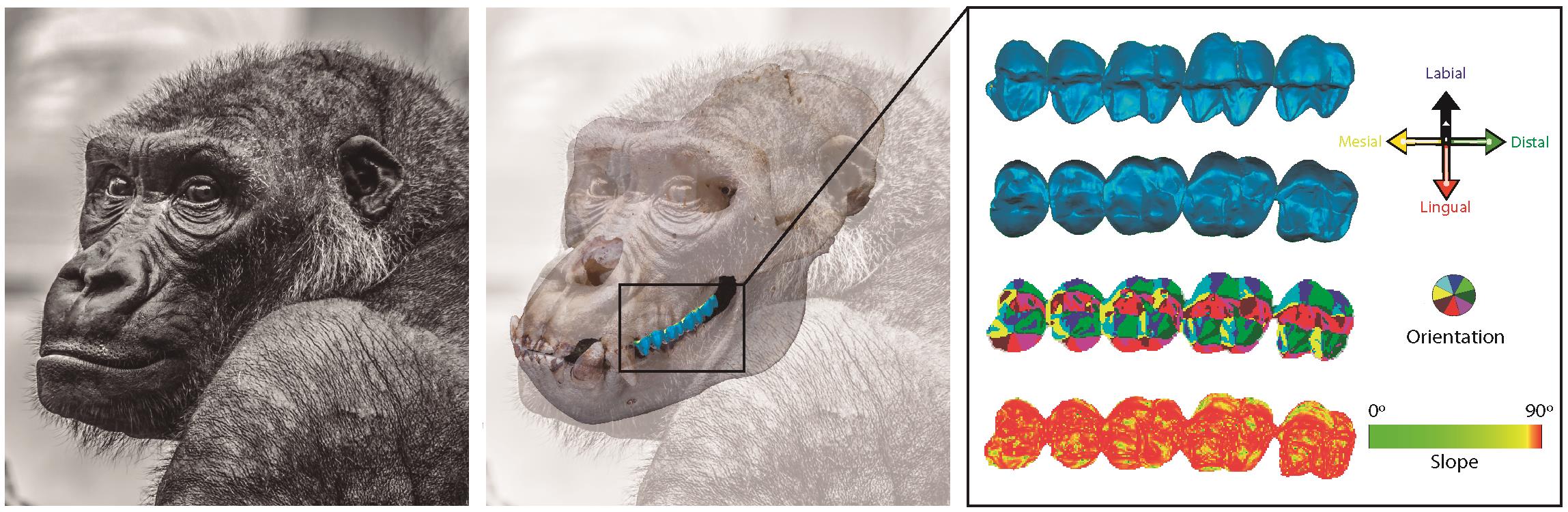
By charting the slopes and crags on animals’ teeth as if they were mountain ranges, scientists at the Smithsonian’s National Museum of Natural History have created a powerful new way to learn about the diets of extinct animals from the fossil record.
Understanding the diets of animals that lived long ago can tell researchers about the environments they lived in and help them piece together a picture of how the planet has changed over deep time. The new quantitative approach to analysing dentition, reported on 21 November in the journal Methods in Ecology and Evolution, will also give researchers a clearer picture of how animals evolve in response to changes in their environment.
A 3D reconstruction of the teeth of a western gorilla (Gorilla gorilla).
Years of research on the evolution of ancient life, including the dinosaurs, have been questioned after a fatal flaw in the way fossil data are analysed was exposed by scientists from the universities of Reading and Bristol.
Studies based on the apparently flawed method have suggested Earth’s biodiversity remained relatively stable – close to maximum carrying capacity – and hinted many signs of species becoming rapidly extinct are merely reflections on the poor quality of the fossil record at that time.
However, new research by scientists at the University of Reading suggests the history of the planet’s biodiversity may have been more dynamic than recently suggested, with bursts of new species appearing, along with crashes and more stable periods.




 Methods Blog