New Associate Editor: Sarah Goslee

Today, we are pleased to be welcoming a new member of the Methods in Ecology and Evolution Associate Editor Board. Sarah Goslee joins us from the USDA Agricultural Research Service in the USA and you can find out a little more about her below.

Sarah Goslee

“‘Why is this plant growing here?’ Tackling this question has led me through wetlands, forests, deserts and grasslands. I’ve poked at this question from the scale of plant traits all the way up to satellite imagery. I employ tools that include multivariate analysis, community and landscape diversity metrics, simulation modelling, and spatial classification. My current focus is on agricultural decision support tools for pasture and rangeland.”

Sarah will be handling Applications articles for the journal. Applications papers describe new software, equipment or other practical tools, with the intention of promoting and maximising the uptake of these new approaches. All of our published Applications articles are freely available to everyone.
Continue reading “New Associate Editor: Sarah Goslee”

Writing Manuscripts: The Alternative ‘Guide to Authors’

Post provided by EMMA SAYER

If the reviewer doesn't get it, you haven't explained it clearly enough! © Chelm261
If the reviewer doesn’t get it, you haven’t explained it clearly enough! ©Chelm261

“If the reviewer doesn’t get it, you haven’t explained it clearly enough!” This is one quote from my PhD supervisor that I haven’t forgotten. Getting research funded and published depends to a very large extent on our ability to get the point across. Although scientific texts appear to differ wildly from other forms of writing, a good research paper actually follows the same basic principles of effective communication as a newspaper article or advertising text.

There are some fairly simple guidelines on presenting and structuring written information to get the point across and highlight the key messages that are very useful for manuscripts, thesis chapters, proposals, basically any kind of academic writing. At Functional Ecology, we’ve collected tips and tricks from various sources to help authors effectively communicate their research and ideas. Here are our key points:

1) Know Your Audience

A research paper is about communicating your research in a way that makes sense to others. © Vinch

The central principle for any type of communication is: know your audience. A research paper isn’t just about presenting information – it’s about communicating your research to others. When you start preparing a manuscript, you need to think about who will read it. In the first instance, this is probably a busy editor or reviewer, so you should make sure that you get your key messages across without making your readers work too hard. Good science writing isn’t about using clever-sounding words and sentences, it’s about getting the point across in such a way that readers can understand the research and reach the right conclusion (i.e. the one you want them to reach). Continue reading “Writing Manuscripts: The Alternative ‘Guide to Authors’”

New Associate Editors

Today we are welcoming three new Associate Editors to Methods in Ecology and Evolution: Nick Golding (University of Melbourne, Australia), Rachel McCrea (University of Kent, UK) and Francesca Parrini (University of the Witwatersrand, South Africa). They have all joined on a three-year term and you can find out more about them below. Nick Golding “I develop statistical models and software for mapping the distributions of species and diseases. I’m particularly interested in … Continue reading New Associate Editors

Issue 7.2: Demography Beyond the Population

Issue 7.2 is now online!

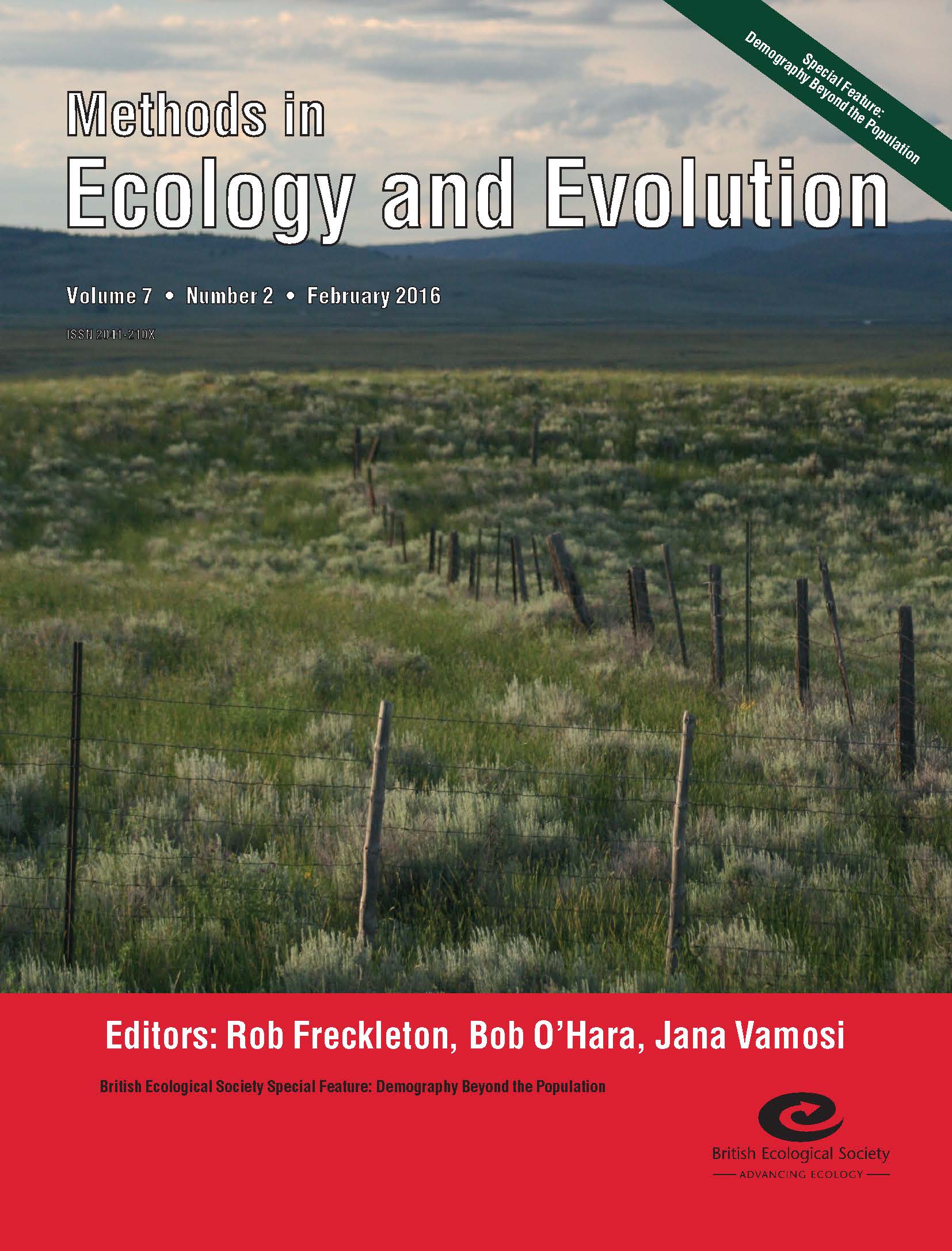
Sagebrush steppe in eastern Idaho, USA
© Brittany J. Teller

The February issue of Methods is now online! As you may have seen already, it includes the BES cross-journal Special Feature: “Demography Beyond the Population“. There are also eight other wonderful articles to read.

We have four articles in the Demography Beyond the Symposium Special Feature. You can read an overview of them by two of the Feature’s Guest Editor Sean McMahon and Jessica Metcalf here (Sean and Jessica are also Associate Editors of Methods).

If you’d like to find out more about each of the individual papers before downloading them, we have blog posts about each one. Daniel Falster and Rich Fitzjohn discuss the development of plant and provide some advice on creating simulation models in Key Technologies Used to Build the plant Package (and Maybe Soon Some Other Big Simulation Models in R). There is a look back at the evolution of Integral Projection Models from Mark Rees and Steve Ellner in How Did We Get Here From There? A Brief History of Evolving Integral Projection Models. In Inverse Modelling and IPMs: Estimating Processes from Incomplete Information Edgar González explains how you can estimate process that you can’t observe. And keep an eye out for Brittany Teller’s blog post coming next week!

Don’t wait too long to get the Demography Beyond the Population Special Feature papers though, they’re freely available for a limited time only

Continue reading “Issue 7.2: Demography Beyond the Population”

How Did We Get Here From There? A Brief History of Evolving Integral Projection Models

Post provided by MARK REES and Steve Ellner

The Early Days: Illyrian Thistle and IBMs

Illyrian Thistle
Illyrian Thistle

Back in 1997 MR was awarded a travel grant from CSIRO to visit Andy Sheppard in Canberra. CSIRO had been collecting detailed long-term demographic data on several plant species and Andy was keen to develop data-driven models for management.

Andy decided Illyrian thistle (Onopordum Illyricum) would be a good place to start, as this was the most complicated in terms of its demography. The field study provided information on size, age and seed production. The initial goal was to quantify the impact of seed feeders on plant abundance, but after a few weeks of data analysis it became apparent that the annual seed production per quadrat was huge (in the 1000s) but there were always ~20 or so recruits. This meant that effects of seed feeders (if any) occurred outside the range of the data, which wasn’t ideal for quantitative prediction.

So the project developed in a different direction. Onopordum is a monocarpic perennial (it lives for several years then flowers and dies) and Tom de Jong and Peter Klinkhamer had recently developed models to predict at what size or age monocarps should flower, so it seemed reasonable to see if this would work. Continue reading “How Did We Get Here From There? A Brief History of Evolving Integral Projection Models”

Methods Beyond the Population

Post Provided by SEAN MCMAHON and JESSICA METCALF

Demography Beyond the Population” is a unique Special Feature being published across the journals of the British Ecological Society.  The effort evolved from a symposium of the same name hosted in Sheffield, UK last March. Both the meeting and the Special Feature were designed to challenge ecologists from a range of fields whose research focuses on populations.

The participants were charged with sharing how they are pushing the work they do beyond the stage where the population is the focus into research where the population is just the beginning and the focus spans scales, systems and tools. This encompasses a broad suite of biological research, including range modelling, disease impacts on communities, biogeochemistry, evolutionary theory, and conservation biology. The meeting was a great success, and this Special Feature should be equally valuable to the broad readership of the BES journals.

Methods in Ecology and Evolution has a special place in the Special Feature, hosting four papers. These papers not only introduce new efforts in population biology, they provide the methods that other scientists can use to implement them. With the tools provided by these four papers, researchers will be able to advance forest modelling, evolutionary theory, climate change biology and statistical inference of hidden population parameters.  Seriously good stuff! Continue reading “Methods Beyond the Population”

Demography Beyond the Population Webinar: Register for Free Now

Webinar logoRegister for FREE for the first ever BES Publishing webinar based on our forthcoming Demography Beyond the Population Special Feature.

This hour long webinar will begin at 1pm (GMT) on Tuesday 1 March. It highlights some of the excellent articles soon to be published in the British Ecological Society journals Special Feature entitled “Demography Beyond the Population”. The Special Feature is a collaborative effort including articles in all six BES journals. This is the first time such a large ecological collaboration has been attempted worldwide. Using a cross-journal approach has allowed us to highlight the strongly interdisciplinary nature of the field of demography to its fullest potential as well as to lay down the foundations for future directions at the interface of ecology, evolution, conservation biology and human welfare. The webinar has several international speakers and will discuss the articles in the Special Feature and the implications for demography research going forward. Continue reading “Demography Beyond the Population Webinar: Register for Free Now”

Methods in Ecology and Evolution 2015: The Year in Review

Happy New Year! We hope that you all had a wonderful Winter Break and that you’re ready to start 2016. We’re beginning the year with a look back at some of our highlights of 2015. Here’s how last year looked at Methods in Ecology and Evolution.

The Articles

We published some amazing articles in 2015, too many to mention them all here. However, we would like to say a massive thank you to all of the authors, reviewers and editors who contributed to the journal last year. Without your hard work, knowledge and generosity, the journal would not be where it is today. We really appreciate all of your time and effort. THANK YOU!

mee312268_CoverOpportunities at the Interface between Ecology and Statistics

There was only one Special Feature in the journal this year, but it was a great one. Arising from the 2013 Eco-Stats Symposium at the University of New South Wales and guest edited by Associate Editor David Warton, Opportunities at the Interface between Ecology and Statistics was one of the highlights of 2015 for us. It consists of seven articles written collaboratively by statisticians and ecologists and highlights the benefits of cross-disciplinary partnerships. Continue reading “Methods in Ecology and Evolution 2015: The Year in Review”

New Associate Editor: Anne Chao

Today, we are pleased to be welcoming a new member of the Methods in Ecology and Evolution Associate Editor Board. Anne Chao joins us from the National Tsing Hua University in Taiwan and you can find out a little more about her below.

Anne Chao

Anne Chao

“I am 60% statistician, 30% mathematician and 10% ecologist. Mathematical and statistical problems in ecology and evolution fascinate me. My current research interests include statistical inferences of biodiversity measures (for example taxonomic, phylogenetic, and functional diversities along with related similarity/differentiation indices), and statistical analysis of ecological and environmental survey data (such as standardising biological samples and rarefaction/extrapolation techniques).”

Anne has been very engaged with the journal over the past few years as a regular reviewer and as an author. Her first article in Methods, Entropy and the species accumulation curve‘ (written with YT Wang and Lou Jost) was published in 2013 and is now freely available. Continue reading “New Associate Editor: Anne Chao”

The DOs and DON’Ts of Selecting Preferred Reviewers

Like many journals, Methods in Ecology and Evolution asks authors to submit a list of preferred reviewers along with their manuscript. This can be a difficult task and is often one that is overlooked or rushed when submitting. However, this list can be very important in the peer review process.

Why Do We Need Preferred Reviewers?

©Nic McPhee
©Nic McPhee

There are a number of reasons that we ask authors to provide preferred reviewers. These suggestions can be extremely useful in a number of situations. For example, if the Associate Editor is struggling to find referees for a paper, the preferred reviewers become a very valuable resource. Not only are they potential reviewers, but if they are unable to review the paper they can suggest other people who might be able to.

As Methods is a generalist journal, sometimes papers are submitted that do not fit perfectly into the areas of expertise of our Associate Editors. In cases such as these, the preferred reviewers can be a wonderful starting point for the reviewer search. Providing the Editors with a good list of experts in the subject (who they may not know off the top of their head) can make the peer review process quicker and easier for everyone involved.

While Editors are by no means required or obliged to choose the reviewers that authors suggest, the list can often be a source of inspiration. If the Editor chooses not to invite any of the preferred reviewers, they may use the suggestions to try to find people with similar expertise.

Providing a good list of preferred reviewers can speed up the peer review process and make it a much less stressful experience. So, what makes a preferred reviewer list good or bad? The DOs and DON’Ts below should help you to suggest the right reviewers for your paper. Continue reading “The DOs and DON’Ts of Selecting Preferred Reviewers”