10th Anniversary Volume 8: Phylogenetic tree visualization with multivariate data

Post provided by Guangchuang Yu and Tommy Tsan-Yuk Lam
To celebrate the 10th Anniversary of the launch of Methods in Ecology and Evolution, we are highlighting an article from each volume to feature in the Methods.blog. For Volume 8, we have selected ‘ggtree: an r package for visualization and annotation of phylogenetic trees with their covariates and other associated data‘ by Yu et al. (2016).

In this post, the authors share their inspiration behind the ggtree package for R and present new resources of ggtree and a series of other related packages.

The team publishing the ggtree paper is working in the field of emerging infectious diseases. Particularly the corresponding author Tommy Lam (TL) has been advocating the integration of different biological and epidemiological information in the studies of fast-evolving viral pathogens. The lead author Guangchuang Yu (GY) joined The University of Hong Kong to pursue his doctorate degree under the supervision of TL and Yi Guan (co-author in the paper), as he was very curious about the application of genomics and phylogenetics in the study of emerging infectious diseases.

Continue reading “10th Anniversary Volume 8: Phylogenetic tree visualization with multivariate data”
Phylogenies, Trait Evolution and Fancy Glasses

Post provided by Daniel S. Caetano

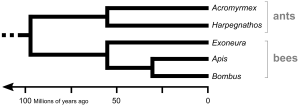
Phylogenetic trees represent the evolutionary relationships among different lineages. These trees give us two crucial pieces of information:

  1. the relationships between lineages (which we can tell from the pattern of the branches (i.e., topology))
  2. the point when lineages separated from a common ancestor (which we can tell from the length of the branches, when estimated from genetic sequences and fossils).

Phylogeny of insects inferred from genetic sequences showing the time of divergence between ants and bees.

As systematic biologists, we are interested in the evolutionary history of life. We use phylogenetic trees to uncover the past, understand the present, and predict the future of biodiversity on the planet. Among the tools for this thrilling job are the comparative methods, a broad set of statistical tools built to help us understand and interpret the tree of life.

Here’s a Tree, Now Tell Me Something

The comparative methods we use to study the evolution of traits are mainly based on the idea that since species share a common evolutionary history, the traits observed on these lineages will share this same history. In the light of phylogenetics, we can always make a good bet about how a species will look if we know how closely related it is to another species or group. Comparative models aim to quantify the likelihood of our bet being right and use the same principle to estimate how fast evolutionary changes accumulate over time. Continue reading “Phylogenies, Trait Evolution and Fancy Glasses”

rotl Paper Published

THIS PIECE WAS ORIGINALLY POSTED ON THE ROPENSCI BLOG.

We (Francois MichonneauJoseph Brown and David Winter) are excited to announce a paper describing rotl, our package for the Open Tree of Life data, has been published. The full citation is:

Michonneau, F., Brown, J. W., Winter, D. J. (2016), rotl: an R package to interact with the Open Tree of Life data. Methods in Ecology and Evolution. doi: 10.1111/2041-210X.12593

The paper, which is freely available, describes the package and the data it wraps in detail. Rather than rehash the information here, we will use this post to briefly introduce the goals of the package and thank some of the people that helped it come to be.

What Data Does Open Tree Have and How Can rotl Help You Get It?

The Open Tree of Life combines knowledge from thousands of scientific studies to produce a single source of information about the relationships among all species on earth. In addition to storing the trees and taxonomies that go into this project, the Open Tree provides a “synthesis tree” that represents this combined knowledge. The Open Tree data can be accessed via the web page linked above, and through an API. rotl takes advantage of this API to give R users the ability to search for phylogenetic information and import the results into their R sessions. The imported data can then be used with the growing ecosystem of packages for phylogenetic and comparative biology in R. Continue reading “rotl Paper Published”

Introducing Biodiverse: Phylodiversity Made Easy

Post provided by SHAWN LAFFAN and ANDREW THORNHILL

© Shawn Laffan
© Shawn Laffan

Phylodiversity indices are increasingly used in spatial analyses of biodiversity, driven largely by the increased availability of phylogenetic trees and the tools to analyse them. Such analyses are integral to understanding evolutionary history and deciding where to allocate conservation resources.

Phylogenetic Indices: The Current Favourites

The most commonly used phylogenetic index is Faith’s Phylogenetic Diversity (PD; Faith 1992). PD is the phylogenetic analogue of taxon richness and is expressed as the number of tree units which are found in a sample.

More recently developed phylodiversity indices adapt the calculation of PD by adjusting the branch lengths of a sample using the local lineage range sizes and abundances, for example Phylogenetic Endemism (PE) and Abundance weighted Evolutionary Diversity (AEDt). In PE the length of each branch in a sample is multiplied by the fraction of its total geographic range found in that sample. The AEDt index uses the same general approach, but weights each branch by the fraction of total abundances found in the sample. The weighting process is generic, so one can scale the branch lengths by any relevant factor, for example the threat status (Faith 2015). Continue reading “Introducing Biodiverse: Phylodiversity Made Easy”

Robert May Prize 2011

Each year our editors select the best paper published in Methods by a young researcher. We are delighted to announce that this year’s winner of the Robert May Prize is Tyler Kuhn for his paper co-authored with Arne Ø. Mooers and Gavin H. Thomas A simple polytomy resolver for dated phylogenies published in vol. 2.5 of the journal. Tyler and co-authors present a simple approach … Continue reading Robert May Prize 2011