Habitat destruction and degradation represent serious threats to biodiversity, and quantification of land-use change over time is important for understanding the consequences of these changes to organisms and ecosystem service provision. Historical land-use maps are important for documenting how habitat cover has changed over time, but digitizing these maps is a time consuming process. HistMapR is an R package designed to speed up the digitization … Continue reading Digitizing Historical Land-use Maps with HistMapR
Nature is complicated. As a scientist, you might say, “Well, duh,” but as students of nature, this complexity is probably the single greatest challenge we must face in trying to dissect the hows and whys of the natural world.
History is a Set of Lies Agreed Upon: Moving beyond ANOVA
For a long time, we tried to strip this complexity away by conducting very controlled experiments adhering to rigid designs. The ‘two-way fully-crossed analysis of variance’ will be familiar to anyone who has taken even the most basic stats class, because, for many decades, it was the gold standard for any experiment.
It might be tough to manipulate this whole reef.
The problem is: the real world doesn’t adhere to an ANOVA design. By this, I mean that by their very nature, manipulative experiments are artificial. It’s hard—if not impossible—to manipulate an entire forest or a coral reef, and as such, we retreat to more tractable, smaller investigations. There is certainly a lot of value in determining whether the phenomenon can occur, but these tightly regulated designs say nothing about whether they are likely to occur, particularly at the scales most relevant to humanity.
To get at the latter point, we must leave the safety of the greenhouse. However, our trusty ANOVA toolbox isn’t very useful anymore, because real-world data often violate the most basic statistical assumptions, not to mention the presence of numerous additional influences that may drive spurious relationships. Continue reading “piecewiseSEM: Exploring Nature’s Complexity through Statistics”
To truly understand how species’ distributions vary through space and time, biogeographers often have to make use of analytical techniques from a wide array of disciplines. As such, these papers cover advances in fields such as evolutionary analysis, biodiversity definitions, species distribution modelling, remote sensing and more. They also reflect the growing understanding that biogeography can include experiments and highlight the increasing number of software packages focused towards biogeography.
This Virtual Issue was compiled by Methods in Ecology and Evolution Associate Editors Pedro Peres-Neto and Will Pearse (both of whom are involved in the conference). All of the articles in this Virtual Issue are free for a limited time and we have a little bit more information about each of the papers included here: Continue reading “Biogeography Virtual Issue”
The paper, which is freely available, describes the package and the data it wraps in detail. Rather than rehash the information here, we will use this post to briefly introduce the goals of the package and thank some of the people that helped it come to be.
What Data Does Open Tree Have and How Can rotl Help You Get It?
The Open Tree of Life combines knowledge from thousands of scientific studies to produce a single source of information about the relationships among all species on earth. In addition to storing the trees and taxonomies that go into this project, the Open Tree provides a “synthesis tree” that represents this combined knowledge. The Open Tree data can be accessed via the web page linked above, and through an API. rotl takes advantage of this API to give R users the ability to search for phylogenetic information and import the results into their R sessions. The imported data can then be used with the growing ecosystem of packages for phylogenetic and comparative biology in R. Continue reading “rotl Paper Published”
Our 5th Anniversary Special Feature is a collection of six articles (plus an Editorial from Executive Editor Rob Freckleton) that highlights the breadth and depth of topics covered by the journal so far. It grew out of our 5th Anniversary Symposium – a joint event held in London, UK and Calgary, Canada and live-streamed around the world in April 2015 – and contains papers by Associate Editors, a former Robert May prize winner and regular contributors to the journal.
The six articles are based on talks given at last May’s Symposium. They focus on:
In his Editorial for the Special Feature, Rob Freckleton looks to the future. In his words: “we hope to continue to publish a wide range of papers on as diverse a range of topics as possible, exemplified by the diversity of the papers in this feature”.
If you are attending Evolution, as well as attending the fabulous talks mentioned by Hélène below, do stop by booth 125 to see our BES colleague Simon Hoggart. Simon is the Assistant Editor of Journal of Animal Ecology and would be happy to answer your questions about any of our journals or any of the other work we do here at the BES.
RPANDA: a time machine for evolutionary biologists
Imagine “Doc”, Marty’s friend in Back to the Future, trying to travel back millions of years in an attempt to understand the history of life. Instead of building a time machine from a DeLorean sports car powered by plutonium, he could dig fossils, or more likely, he would use molecular phylogenies.
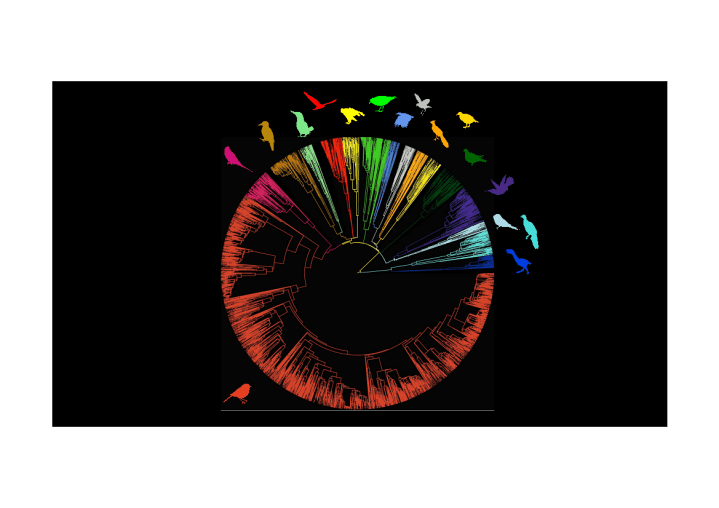
Molecular phylogenies are family trees of species that can be built from data collected today: the genes (molecules) of present-day species (Fig 1). They are often thought of as trees, in reference to Darwin’s tree of life. The leaves represent the present: species that can be found on Earth today. The branches represent the past: ancestral species, which from time to time split, giving rise to two independent species. The structure of the tree tells us which species descend from which ancestors, and when their divergence happened.
Fig 1: The phylogenetic tree of all birds (adapted from Jetz et al. 2012). Each bird order is represented by a single bird silloutter and a specific colour (the most abundant order of Passeriformes, for example is represented in dark orange). Each terminal leaf represents a present-day bird species, while internal branches represent the evolutionary relationships among these species.
Today, we are pleased to be welcoming a new member of the Methods in Ecology and Evolution Associate Editor Board. Will Pearse joins us from McGill University in Canada and you can find out a little more about him below. Will Pearse “I am an evolutionary ecologist and use phylogeny to link the evolution of species’ traits with their ecological community assembly. I’m interested in phylogenetic methods, macro-evolution of species’ traits, community assembly … Continue reading New Associate Editor: Will Pearse
The seemingly basic question of whether a population is increasing, decreasing, or stable can be one of the most difficult to answer. Collecting data on rare and elusive species is hard. Imagine trying to detect a handful of fisher or wolverine across hundreds of thousands of acres – it is physically demanding, time consuming and logistically complicated. And that’s just to do it once! To monitor a population for changes, you have to repeat these surveys regularly over many years. The long-term monitoring that is necessary for conservation requires careful planning and a substantial commitment of resources and funding. So before we spend these valuable resources, it’s critical to know whether the data we are collecting can help us to answer our questions. Continue reading “Spatially-explicit Power Analysis: A First Step for Occupancy-Based Monitoring”
Typically, ecology courses contain at least a day of matrix population models. So most ecologists are somewhat familiar with how simple life cycles (and complex ones) can be depicted and analysed using matrix models. Briefly, these models represent what happens to individuals over a certain time interval (do they die? do they reproduce? if so, how much?). What individuals do in the context of these models can then be used to study the dynamics of a population.
Often, individuals are classified by size in matrix models, as small individuals tend to have different survival, growth and reproduction rates than large ones. But how many classes do you need to model the dynamics of a size-structured population properly? Instead of choosing arbitrary size class boundaries, Easterling, Ellner and Dixon (2000) came up with the idea of using continuous size variables and integrals to define a population model… and that’s how the first Integral Projection Model (‘IPM’ for us friends) came to be.
Naturally, for the development of a new demographic tool to prove useful to the scientific community, it must be flexible enough to be ‘one-size-fits-all’… and the needs of ecologists, evolutionary biologists and conservation biologists – who have to date used extensively size-based matrix models – are rather variable in size, colour and shape. Continue reading “Stage-dependent Demographic Modelling at Your Finger Tips”




 Methods Blog