Post provided by Marta Skowron Volponi Has the buzzing sound of a wasp flying past your ear ever made you recoil in fear of being stung? What if these buzzes are a warning display aimed at potential predators, just like the bees’ and wasps’ bright colouration that sends a message: “don’t touch me, I’m dangerous”? Or perhaps they are audio messages meant for other wasps? … Continue reading The buzzOmeter: Recording buzzing insects in motion
Post provided by Dan Parker, Dr Stanislav Roudavski, Therésa Jones & Dr Kylie Soanes The cover of our April issue shows a small model of a 3D-printed artificial hollow created by Parker et al. as part of their article ‘A framework for computer-aided design and manufacturing of habitat structures for cavity-dependent animals‘. In this cover story, the authors explain their method and what it means … Continue reading New hope for urban wildlife
The cover of our March issue shows a female Eurasian otter (Lutra lutra), with its young kit bringing a crab to shore before eating it. The photographer, Alan Seymour, had been watching the otter from a distance, while laying low behind a large boulder. Direct observations of trophic interactions take a lot of time and skill, especially concerning cryptic species (e.g., semi-aquatic mammals, small invertebrates). Accurately and precisely identifying prey items is mostly impossible by observation. Molecular methods, such as DNA metabarcoding, offer a sensitive approach for investigating trophic interactions of cryptic species; however, this high sensitivity can introduce errors. In this post, the authors discuss potential sources of errors in dietary metabarcoding datasets, and how to use minimum sequence copy thresholds to carefully remove them, detailed in their Methods in Ecology and Evolution article “An assessment of minimum sequence copy thresholds for identifying and reducing the prevalence of artefacts in dietary metabarcoding data”.
A grey seal pup next to the unoccupied aerial system (UAS) used in this study. Photo credit: Michelle Shero.
To survive and reproduce, all animals must be able to extract sufficient energy from their environment. It takes energy to forage, but animals can recover those calories if they can successfully capture enough prey – and the animal’s weight tells us about its net energetic costs versus gains.Animals that remain in positive energy-balance can then afford to devote more energy towards growth and reproduction.In this blog post, Michelle Shero of Woods Hole Oceanographic Institution guides us through a new method outlined in her team’s recent Methods in Ecology and Evolution paper ‘Tracking wildlife energy dynamics with unoccupied aircraft systems and three-dimensional photogrammetry’. The team uses drone imagery to 3-D model and ‘weigh’ large groups of free-living animals.
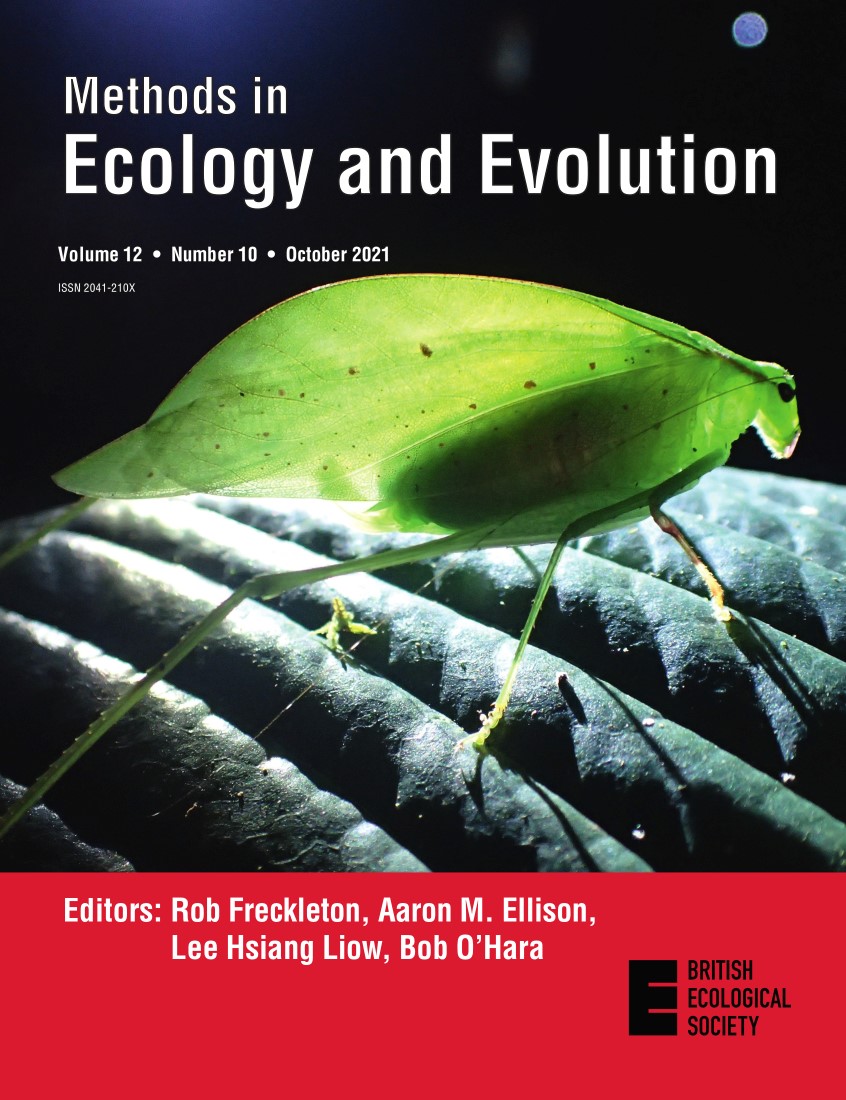
The cover of our October issue shows a katydid feeding on a leaf in the Tirimbina Rainforest National Wildlife Refuge of Costa Rica. Once digested, nitrogen from the leaf is incorporated into the katydid’s tissues in the form of amino acids, with slight modification to their stable nitrogen isotope values (δ15N). In this post the authors discuss the importance of understanding and accounting for variability in primary producer amino acid δ15N values when characterizing where consumers are positioned within food webs, detailed in their Methods in Ecology and Evolution article “Meta-analysis of primary producer amino acid δ15N values and their influence on trophic position estimation.”
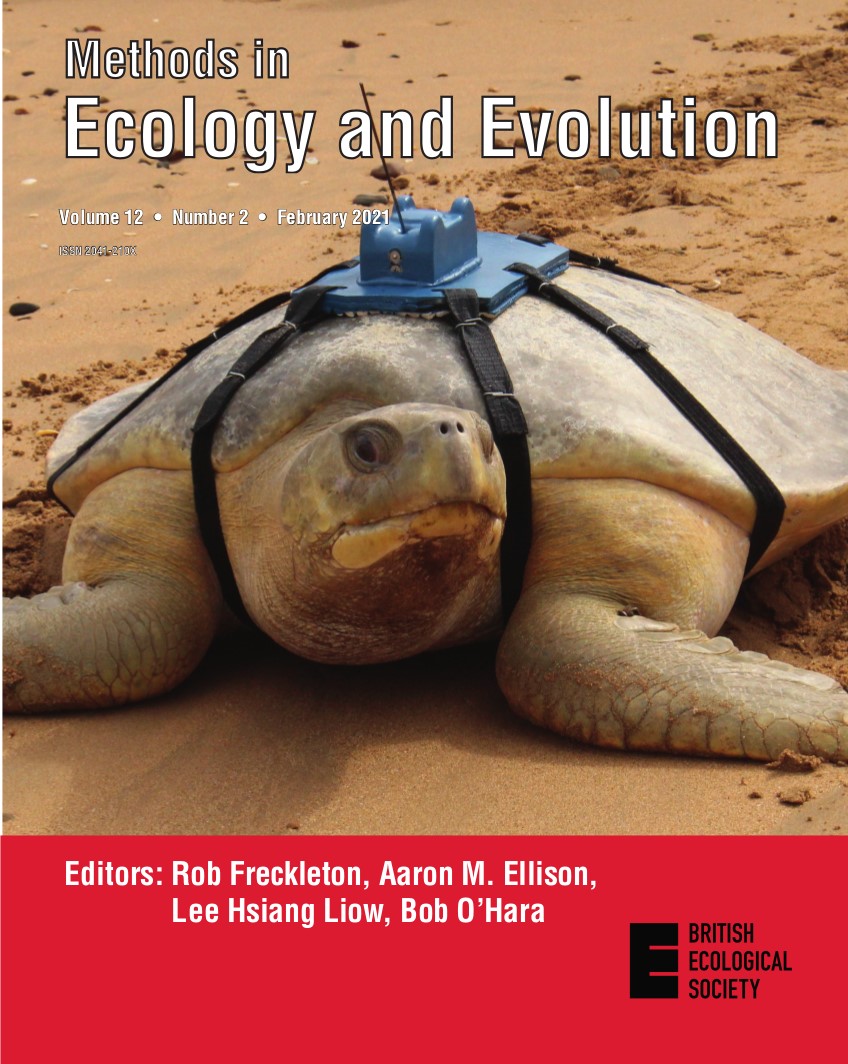
Natator depressus leaving a nesting beach, fitted with an accurate Fastloc-GPS tag. Picture credit: C.J.Limpus.
The cover of our February issue shows a flatback sea turtle (Natator depressus) leaving a nesting beach, fitted with an accurate Fastloc‐GPS tag. In this post, Takahiro Shimada and Mark G. Meekan explain how they analysed turtle tracking data to demonstrate their new method for assessing appropriate sample sizesin the article ‘Optimising sample sizes for animal distribution analysis using tracking data’.
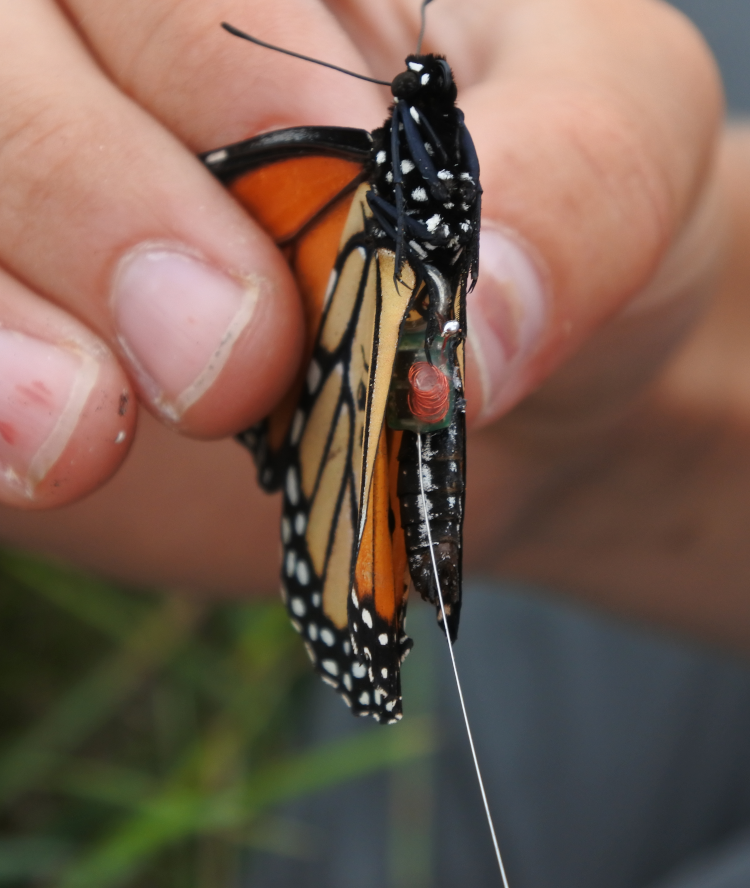
LB-2X transmitter attached to a monarch butterfly.
Understanding animal movement across varying spatial and temporal scales is an active area of fundamental ecological research, with practical applications in the fields of conservation biology and natural resource management. Advancements in tracking technologies, such as GPS and satellite systems, allow researchers to obtain more location information for a variety of species than ever before. It’s an exciting time for movement ecologists! However, entomologists studying insect movement are still limited because of the large size of tracking devices relative to the small size of insects.




 Methods Blog