Individual History and the Matrix Projection Model

Post provided by Rich Shefferson
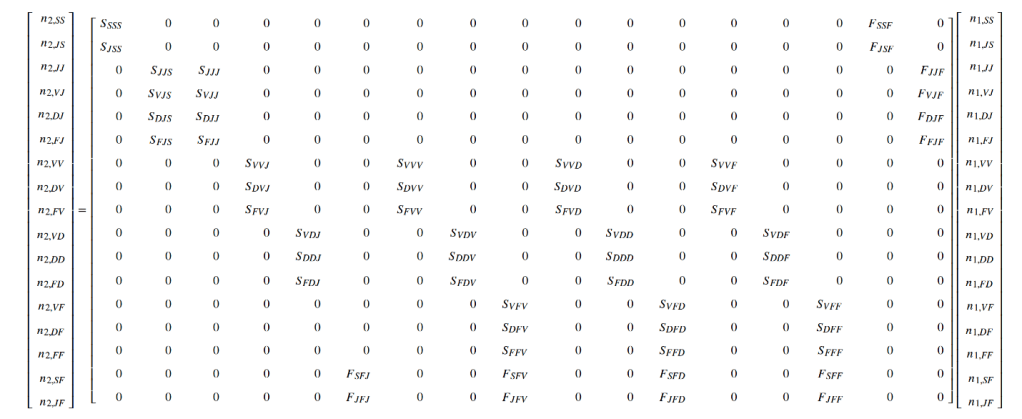
A single time-step projection of a historical matrix projection model (hMPM), for a 7 life stage life history model of Cypripedium parviflorum, the small yellow lady’s slipper. In this case, the vector of biologically plausible stage pairs in time 2 is equal to the full projection matrix multiplied by the vector of biologically plausible stage pairs in time 1.

Matrix projection modeling is a mainstay of population ecology. Ecologists working in natural area management and conservation, as well as in theoretical and academic realms such as the study of life history evolution, develop and use these models routinely. Matrix projection models (MPMs) have advanced dramatically in complexity over the years, originating from age-based and stage-based matrix models parameterized directly from the data, to complex matrices developed from statistical models of vital rates such as integral projection models (IPMs) and age-by-stage models. We consider IPMs to be a class of function-based MPM, while age-by-stage MPMs may be raw or function-based, but are typically the latter due to a better ability to handle smaller dataset. The rapid development of these methods can leave many feeling bewildered if they need to use these methods but lack sufficient understanding of scientific programming and of the background theory to analyze them properly.

Continue reading “Individual History and the Matrix Projection Model”
Tracking the fate of fish

Post provided by David Villegas Ríos

David Ríos tells us about investigating the movement of aquatic animals using telemetry technology and the new Methods article ‘Inferring individual fate from aquatic acoustic telemetry data’.

Photo by Carla Freitas

Aquatic animal telemetry has revolutionized our understanding of the behaviour of aquatic animals. One of the important advantages of telemetry methods, including acoustic telemetry, is that they provide information at the individual level. This is very relevant because it enables investigating the natural variability in behaviour within populations (like here or here), but also because one can investigate what happens to each individual animal and relate it to its natural behaviour. Knowing “what happens to each individual” is normally referred to as “fate” and it can take many forms: some fish may end-up eaten by predators, other may be fished, some of them may disperse, etc. Knowing the fate of each individual fish is crucial as it links ecological processes at the individual level to evolutionary outcomes at the population level.

Continue reading “Tracking the fate of fish”

10th Anniversary Volume 6: Remote Sensing Editor’s Choice

To celebrate our 10th Anniversary, we are highlighting a key article from each of our volumes. For Volume 6, we selected Nondestructive estimates of above‐ground biomass using terrestrial laser scanning by Calders et al. (2014).

In this post, two of our Associate Editors with expertise in remote sensing, Sarah Goslee and Hooman Latifi, share their favourite MEE papers in the fields of remote sensing and biomass estimation.

Continue reading “10th Anniversary Volume 6: Remote Sensing Editor’s Choice”

Announcing our new Associate Editors 2020

Following an open call for applicants in July, we are pleased to welcome 30 new Associate Editors to the Methods in Ecology and Evolution Editorial Board. The researchers joining us span 16 different countries, including our first editors working in Iran, Italy and Portugal. Find out more about them below.

We are really delighted to have further expanded the expertise on our board so that we can continue to promote the development of new methods in ecology and evolution.

Welcome to the team!

Continue reading “Announcing our new Associate Editors 2020”

November Issue Out Now!

The latest issue of Methods in Ecology and Evolution is now online!

Senior Editor Aaron Ellison has selected six Featured Articles this month. You can find out about all of them below. We also have eight Applications articles and seven Practical Tools articles in the November issue that are freely available to everyone – no subscription required!

Continue reading “November Issue Out Now!”

10th Anniversary Volume 6: Nondestructive estimates of above‐ground biomass using terrestrial laser scanning

Post provided by Kim Calders, Glenn Newnham, Andrew Burt, Pasi Raumonen, Martin Herold, Darius Culvenor, Valerio Avitabile, Mathias Disney, and John Armston

To celebrate the 10th Anniversary of the launch of Methods in Ecology and Evolution, we are highlighting an article from each volume to feature in the Methods.blog. For Volume 6, we have selected ‘Nondestructive estimates of above-ground biomass using terrestrial laser scanning by Calders et al. (2014).

In this post, the authors discuss the background and key concepts of the article, and changes in the field that have happened since the paper was published.

Terrestrial laser scanning (TLS) calculates 3D locations by measuring the speed of light between a transmitted laser pulse and its return. Firing hundreds of thousands of pulses per second, these instruments can represent the surroundings in detailed 3D, displaying them as virtual environments made up of high density points. The main applications of commercial instruments in the early 2000s were engineering or mining, but their application in natural forested environments was in its infancy. Forest ecosystems are structurally complex; clear reference points used to register multiple scans are rare and trees move due to wind creating artefacts in the data.

Continue reading “10th Anniversary Volume 6: Nondestructive estimates of above‐ground biomass using terrestrial laser scanning”

Creating a package to infer species coexistence

Post provided by Ignasi Bartomeus, David García-Callejas, and Oscar Godoy

Ignasi Bartomeus and colleagues share the story behind their recent Methods article ‘cxr: A toolbox for modelling species coexistence in R’.

This post recalls the journey on how we ended up developing cxr (acronym for CoeXistence relationships in R), an R package for quantifying interactions among species and their coexistence relationships. In other words, it provides tools for telling apart the situations in which different species can persist together in a community from the cases in which one species completely overcomes another.

Continue reading “Creating a package to infer species coexistence”

Navigating the data-rich world of aquatic acoustic telemetry

Post provided by Kim Whoriskey

Early Career Researcher Kim Whoriskey takes us behind the Methods paper ‘Current and emerging statistical techniques for aquatic telemetry data: A guide to analysing spatially discrete animal detections’ which led to her being shortlisted for our Robert May Prize in 2019.

Understanding how aquatic animals move is becoming increasingly important for protecting them. Knowing where they migrate, how long they stay, and what they do when they travel through changing marine environments provides us with key information on movement corridors, habitat hotspots, and changing population distributions. This information can then be used to help manage and conserve many different aquatic species, from developing guidelines for recreational fishing practices to defining marine spatial planning measures.

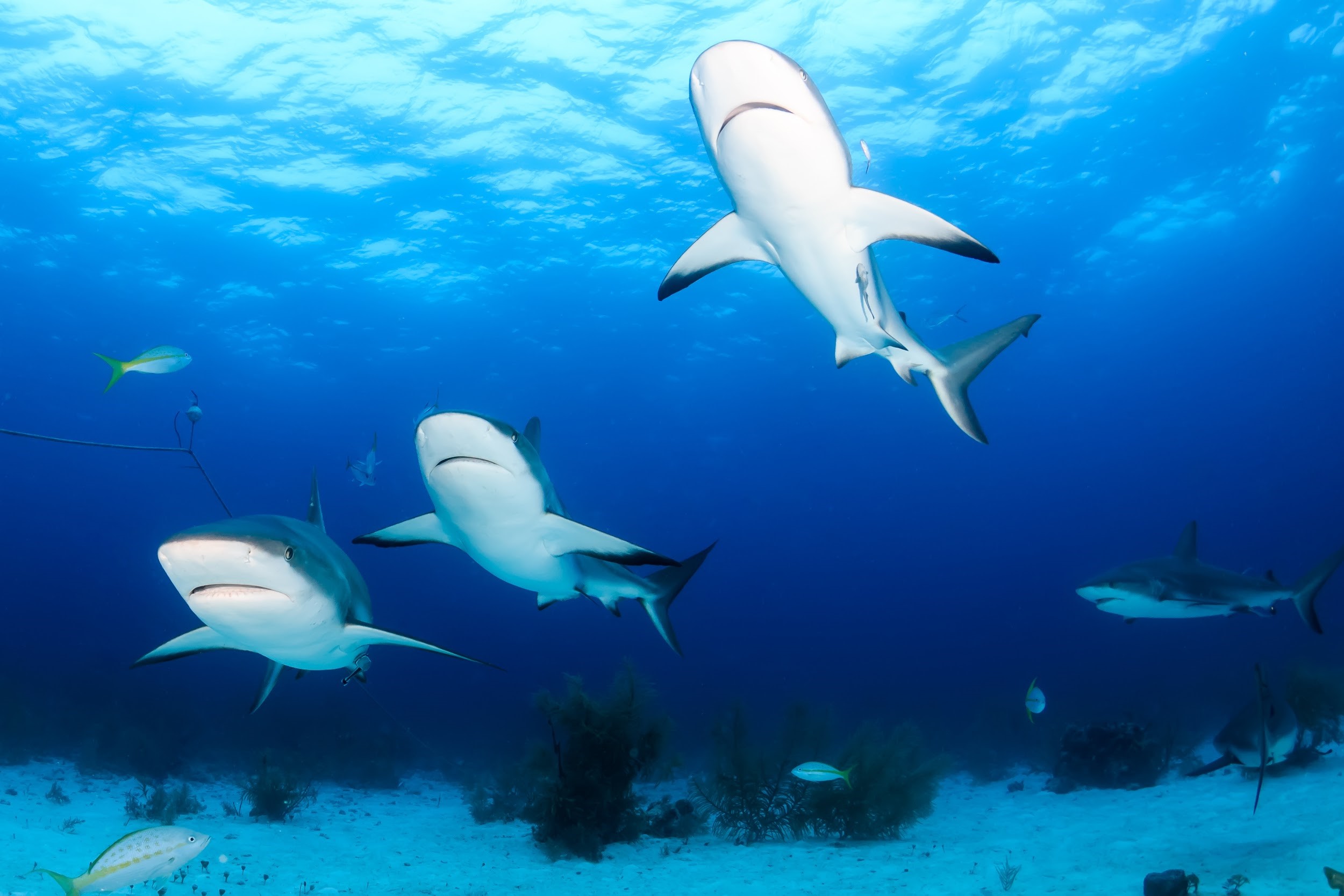
sharks

Continue reading “Navigating the data-rich world of aquatic acoustic telemetry”

Stop, think, and beware of default options

Post provided by Paula Pappalardo (with contributions from Elizabeth Hamman, Jim Bence, Bruce Hungate & Craig Osenberg)

Esta publicación también está disponible en español.

You spent months carefully collecting data from articles addressing your favorite scientific question, you have dozens of articles neatly arranged on a spreadsheet, you found software or code to analyze the data, and then daydream about how your publication will be the most cited in your field while making cool plots. If that sounds familiar, you have probably done a meta-analysis. Meta-analysis uses statistical models to combine data from different publications to answer a specific question.

What you may not have realized when going down the meta-analysis rabbit hole, is that small, seemingly inconsequential, choices can greatly affect your results. If you want to know about one of them lurking behind the scenes… read on!

Continue reading “Stop, think, and beware of default options”

Para, piensa, y ten cuidado con las configuraciones por defecto

Post escrito por Paula Pappalardo (con aportes de Elizabeth Hamman, Jim Bence, Bruce Hungate & Craig Osenberg)

This post is also available in English.

Pasaste meses laboriosamente colectando datos de artículos científicos acerca de tu pregunta favorita, tienes decenas de artículos perfectamente organizados en una base de datos, ya encontraste el programa o código para analizar los datos, y entonces imaginas como tu publicación va a ser la más citada en tu campo de investigación mientras haces unos gráficos lindísimos. Si esto te suena familiar, seguramente has hecho un meta-análisis. Un meta-análisis usa modelos estadísticos para combinar datos de distintas publicaciones para responder a una pregunta específica.

Lo que quizás no te diste cuenta mientras navegabas los pasos del meta-análisis, es que pequeñas decisiones (a veces pareciendo de muy poca importancia) pueden tener grandes efectos en los resultados. Si quieres saber más acerca de una de estas decisiones en particular… ¡sigue leyendo!

Continue reading “Para, piensa, y ten cuidado con las configuraciones por defecto”