Each year Methods in Ecology and Evolution awards the Robert May Prize to the best paper in the journal by an author at the start of their career. Today we present the shortlisted papers for 2019’s award, based on articles published in volume 10 of the journal. The winner will be chosen by the journal’s Senior Editors in a few weeks. Keep an eye on the blog … Continue reading 2019 Robert May Early Career Researcher Prize Shortlist
Artificial intelligence (or AI) is an enormously hot topic, regularly hitting the news with the latest milestone where computers matching or exceeding the capacity of humans at a particular task. For ecologists, one of the most exciting and promising uses of artificial intelligence is the automatic identification of species. If this could be reliably cracked, the streams of real-time species distribution data that could be unlocked worldwide would be phenomenal.
Despite the hype and rapid improvements, we’re not quite there yet. Although AI naturalists have had some successes, they can also often make basic mistakes. But we shouldn’t be too harsh on the computers, since identifying the correct species just from a picture can be really hard. Ask an experienced naturalist and they’ll often need to know where and when the photo was taken. This information can be crucial for ruling out alternatives. There’s a reason why field guides include range maps!
The sending of letters under the pen name ‘St. Valentine’ began back in the middle ages as a way of communicating affection during the practice of courting. Fast forward to 2020 and Valentine’s Day is a day for celebrating romance, but now it typically features the exchange of gifts and cards between lovers.
Executive Editor Rob Freckleton has selected six Featured Articles this month. You can find out about all of them below. We’ve also got six Applications articles and five Open Access articles in the February issue – we’ll talk about all of those here too.
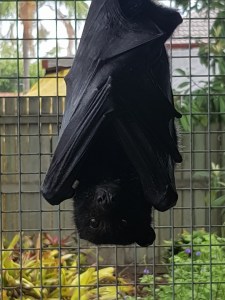
An Australian black flying fox – missing an ear, but fit for release.
Bats. They’re amazing creatures. Long-lived (with relevance to their body size), echolocating (for microbats and some megabats), metabolically-resilient (apparently resilient to most virus infections) flying mammals (with heart beats up to 1200 bpm for hours during flight). There are 1,411 species of this incredible creature. But very little is known about their physiology and unique biological traits. And detailed evolutionary analysis has only just begun.
The problem is, they’re an ‘exotic’ animal (wildlife that most people do not come into contact with). Being a long-lived animal producing minimal offspring (most only have one baby per year), they’re not suited to the kind of experimental studies we do with other animals like mice. Unavoidably, some aspects of biology require the use of tissues and cells. These samples can be used for sequencing, genomics, molecular evolution studies, detailed transcriptomic analysis, functional experiments with specific cell types and much more. Some methodology is beginning to be published – such as capture techniques and wing punch/genomic isolation – but there’s been an absence of protocols for the processing of bats. This is essential for the field to maximise the potential application of each individual and for minimising non-essential specimen collection.
We’re starting 2020 with a great issue – and ALL of the articles are completely free. And they’ll remain free for the whole year. No subscription required.
You can find out more about our Featured Articles (selected by the Senior Editor) below. We also discuss this month’s Open Access, Practical Tools and Applications articles. There are also articles on species distributions, biotic interactions, taxonomic units and much more.
Michael Phelps yw un o’r athletwyr Olympaidd mwyaf clodfawr erioed, ynghyd â’r nofiwr cyflymaf yn y byd. Ac eto, gallai nofio’n gyflymach. Gan wisgo siwt arbennig LZR Racer Speedo, gallai Michael Phelps leihau’i lusgiad hydrodynamig, neu’i wrthiant dŵr, 40% neu fwy. O ganlyniad gallai ei gyflymdra nofio gynyddu dros 4%! Mewn cystadleuaeth, dyna’r gwahaniaeth rhwng gwobrau arian ac aur. Ond, petai Phelps yn anghofio tynnu’i “hosanau llusgo” – sef hosanau rhwystrus a ddyluniwyd i gynyddu gwrthiant dŵr er mwyn cynyddu cryfder y nofiwr – caiff ei gyflymder ei leihau’n sylweddol. Byddai’n ffodus i ennill gwobr efydd!
Mae nofwyr proffesiynol yn gyfarwydd â defnyddio technolegau i wella eu perfformiad drwy leihau eu llusgiad ond ni all hynny gymharu â’r addasiadau a wnaed gan anifeiliaid gwyllt. Mae creaduriaid yn y môr wedi esblygu addasiadau anghredadwy i leihau llusgiad, megis lliflinio eithafol mewn mamaliaid ac adar y môr. Mae hyn yn eu galluogi i symud dan y dŵr mor gyflym ac effeithlon â phosib. Mae morloi, er enghraifft, yn eithaf afrosgo ar y tir ond maent yn osgeiddig ac yn gyflym o dan y dŵr. Mae siâp eu cyrff wedi’i ddylunio er mwyn iddynt symud yn gyflymaf pan fyddant yn nofio.
We have now entered the era of artificial intelligence. In just a few years, the number of applications using AI has grown tremendously, from self-driving cars to recommendations from your favourite streaming provider. Almost every major research field is now using AI. Behind all this, there is one constant: the reliance, in one way or another, on deep learning. Thanks to its power and flexibility, this new subset of AI approach is now everywhere, even in ecology we show in ‘Applications for deep learning in ecology’.
But what is deep learning exactly? What makes it so special?
Deep Learning: The Basics
Deep learning is a set of methods based on representation learning: a way for machines to automatically detect how to classify data from raw examples. This means they can detect features in data by themselves, without any prior knowledge of the system. While some models can learn without any supervision (i.e. they can learn to detect and classify objects without knowing anything about them) so far these models are outperformed by supervised models. Supervised models require labelled data to train. So, if we want the model to detect cars in pictures, it will need examples with cars in them to learn to recognise them.
Hello! This is my first post as Blog Editor for Methods in Ecology and Evolution and I’m thrilled to be starting with an exciting, thought-provoking topic in the wake of Halloween. But first, let me introduce myself. I currently work as a Postdoctoral Fellow and Project Manager in the Hajibabaei Lab at the Centre for Biodiversity Genomics (University of Guelph, ON, Canada) and my undergraduate and postgraduate degrees are both from Swansea University (UK). My research background is largely focused around the application of environmental DNA (i.e. free DNA found in natural environments) to detect and monitor aquatic species and answer ecological questions through both single-species detection and DNA metabarcoding.