Post provided by Pasquale Raia (he/him), Alessandro Mondanaro (he/him) and Silvia Castiglione (she/her) Quo Vadis? Latin for Where Are You Going? was a huge 1951 box office hit produced by Metro Goldwyn Mayer. The film (which is based on an 1896 book wrote by the Polish novelist Henryk Sienkiewicz) was set in ancient Rome during Nero’s reign and is credited for saving MGM from bankruptcy … Continue reading Unde Venis Species? RRphylogeography, a new accurate method finds the area of origin of species
In this post, the authors share their inspiration behind the ggtree package for R and present new resources of ggtree and a series of other related packages.
The team publishing the ggtree paper is working in the field of emerging infectious diseases. Particularly the corresponding author Tommy Lam (TL) has been advocating the integration of different biological and epidemiological information in the studies of fast-evolving viral pathogens. The lead author Guangchuang Yu (GY) joined The University of Hong Kong to pursue his doctorate degree under the supervision of TL and Yi Guan (co-author in the paper), as he was very curious about the application of genomics and phylogenetics in the study of emerging infectious diseases.
To celebrate the 10th Anniversary of the launch of Methods in Ecology and Evolution, we are highlighting an article from each volume to feature on the Methods.blog. For Volume 3, we have selected ‘paleotree: an R package for paleontological and phylogenetic analyses of evolution‘ by David W. Bapst (2012). In this post, David discusses the background to the Application he wrote as a graduate student, and how the field has changed since.
I was a fourth year graduate student when I first had the idea to make an R package. Quite a few people thought it was a bit silly, or a bit of a time-waste, but I thought it was the right thing to do at the time, and I think it has proven to be the right decision in hindsight.
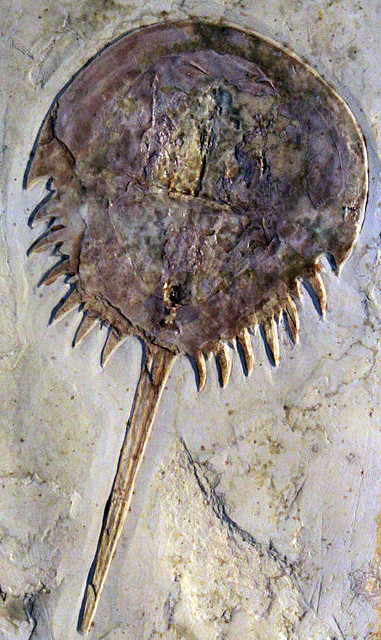
Fóssil de caranguejo-ferradura (Museu de História Natural de Berlin)
Há alguns dias, me deparei com um interessante vídeo sobre os chamados “fósseis vivos”. O vídeo focou mais nos problemas de usá-los como argumentos contra a teoria da evolução, e aproveitei a oportunidade para falar mais sobre essas linhagens longevas.
‘Fóssil vivo‘ é um termo usado para descrever linhagens que acredita-se terem se originado há muito tempo e que mantêm características que se assemelham a seus parentes fósseis. Alguns exemplos bem conhecidos dessas linhagens são os Tuatara da Nova Zelândia (Sphenodon punctatus) e as árvores Gingkos (Gingko biloba).
Fossil of a Horseshoe crab (Museum of Natural History Berlin)
A couple of days ago I came across a nice video (in Portuguese only, sorry) about so-called “living fossils”. The video focused on the problems of using them as arguments against evolution. But I’d like to take the opportunity to talk more about these long-lived lineages.
‘Living fossil’ is a term used to describe lineages that are thought to have been around for a very long time and retain characteristics that resemble of their fossil relatives. A couple of well-known examples of these lineages are the Tuatara of New Zealand (Sphenodon punctatus) and the Gingko tree (Gingko biloba).
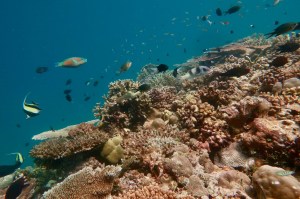
There are an estimated 830,000 species on coral reefs worldwide. At some stage in their lives, nearly all of these species are consumed as prey items. In this super diverse buffet of fishes, corals, crabs, worms, and other critters, the number of possible interactions between predators and prey is nearly inexhaustible.
The extreme diversity of coral reefs has fascinated naturalists for centuries. Pinpointing predator-prey dynamics is essential to fully understand coral reef ecosystem dynamics, and visual analysis of gut contents has been a staple technique of coral reef ecologists. While the joy of spending copious hours looking through a microscope at half-digested marine mush is undeniable, this type of visual inspection has limitations. Even so, visual gut content analysis (along with stable isotope analysis and behavioural observations) has showcased a highly complex dietary network.
To digest this extreme complexity and surmount the hurdle of dietary unknowns, researchers frequently lump fishes into broad trophic categories, such as ‘mobile herbivores’. Broad generalisations are pragmatic and may be help us detect broad ecological trends, but they oversimplify species’ actual dietary preferences. As coral reefs are changing due to anthropogenic disturbances, it’s critical to thoroughly examine how well trophic groupings capture dietary linkages among reef organisms. Continue reading “Using Molecular Power to Reconstruct Hyperdiverse Food Webs”
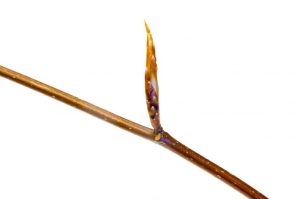
Researchers from Canada and the USA found that tree and shrub genetics can be used to produce more accurate predictions of when leaves will burst bud in the spring. Their study was published in Methods in Ecology and Evolution.
Although climate sceptics might find it hard to believe with this year’s endless snow and freezing temperatures, climate change is making warm, sunny early springs increasingly common. And that affects when trees start to leaf out. But how much?
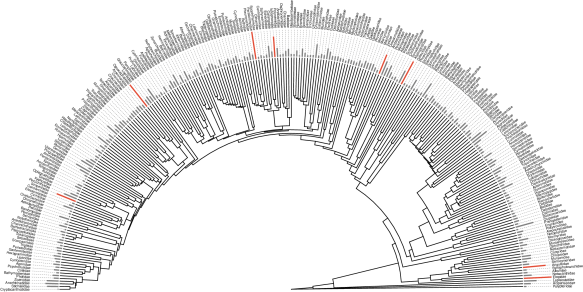
In our recent publication (Rabosky et al. 2018) we assembled a huge phylogeny of ray-finned fishes: the most comprehensive to date! While all of our data are accessible via Dryad, we felt like we could go the extra mile to make it easy to repurpose and reuse our work. I’m pleased to report that this effort has resulted in two resources for the community: the Fish Tree of Life website, and the fishtree R package. The package is available on CRAN now, and you can install it with:
install.packages("fishtree")
The source is on GitHub in the repository jonchang/fishtree. The manuscript describing these resources has been published in Methods in Ecology and Evolution (Chang et al. 2019).



 Methods Blog