Imagine your favourite beach filled with thousands of ducks and gulls. Now envision coming back a week later and finding condos being constructed on that spot. This many ducks in one place surely should indicate this spot is exceptionally good for birds and must be protected from development, right?
Vector-borne viruses (like those transmitted by mosquitoes) are (re)emerging and they’re hurting local economies and public health. Some typical examples are the West Nile, Zika, dengue, chikungunya and yellow fever viruses. The eco-evolutionary and epidemiological histories of these viruses differ massively. But they share one important factor: their transmission potential is highly dependent on the underlying mosquito population dynamics.
Vírus transmitidos por vetores (ex. mosquitos, carraças) estão a (re)emergir e a ter consequências negativas para a saúde pública e para as economias locais. Exemplos típicos recentes de vírus transmitidos por mosquitos incluem o vírus West Nile na América do Norte, Israel e Europa, e os vírus Zika, dengue, chikungunya, Mayaro e febre amarela na América do Sul e África. A epidemiologia, ecologia, e evolução destes vírus são altamente diversas, mas todos eles partilham um fator crítico: o seus potenciais de transmissão são altamente dependentes da dinâmica de população das espécies de mosquitos envolvidas.
Um dos objetivos principais do controlo de doenças infeciosas é prevenir o inicio (ou alterar o curso) de epidemias. Para esse fim, modelos dinâmicos de transmissão têm sido usados com sucesso desde meados do século XX (ex. no contexto de malaria). Esses modelos são aproximações computacionais dos sistemas biológicos reais, permitindo simular uma multitude de cenários nos nossos computadores pessoais, e com tal testar, reconstruir e projetar o potencial e comportamento epidemiológico de patógenos. Quando tais simulações são comparadas com observações reais (ex. número de casos reportados por um sistema de vigilância), os modelos oferecem respostas sobre a mecânica de transmissão e os fatores epidemiológicos ou demográficos que terão contribuído para determinados padrões observados nos dados. Enquanto que modelos dinâmicos são uma das peças fundamentais da epidemiologia contemporânea, dados imperfeitos ou a falta deles pode tornar difícil (se não impossível) a conceção, implementação e utilidade esses modelos. As razões pelas quais dados podem ser imperfeitos são várias, desde sistemas de vigilância fracos, erros humanos, falta de investimento, etc. Continue reading “Mosquitos, o clima e a transmissão de patógenos: como o índice P pode contribuir para saúde pública e educação”
The recent focus on the study of animal social networks has led to some fundamental new insights. These have spanned across fields in ecology and evolution, ranging from epidemiology and learning through to evolution and conservation. Whilst network analysis has been used to address questions about sociality, food webs, bipartite networks and more over the past decade it is now extending into a wider variety … Continue reading Animal Social Networks: Joint Special Feature Open Call
Post provided by Damien Farine, Sebastian Sosa, David Jacoby, Mathieu Lihoreau and Cédric Sueur
Social network visualization. Photo by Martin Grandjean CC-SA.
Here at Methods in Ecology & Evolution and the Journal of Animal Ecology we are excited by the new directions that the next decade of research into animal social networks will bring. We hope to encourage new advances in the study of animal social networks by calling for high-quality papers for a cross-journal Special Feature on animal social networks. Below, Damien Farine and the Special Feature Guest Editors have reviewed some areas of animal social network research that deserve particular attention.
Methodological Gaps
Network Metrics
There are a wide variety of network metrics (node-based, dyadic, and global) and the application and development of new metrics continue to evolve. It is crucial to consider how the values generated by a network metrics (new and old) are interpreted biologically and recognize their limitations. It would be useful to have manuscripts that address questions about:
How mathematical definitions of different network metrics translate to biological processes;
Which metrics provide similar, redundant, or unique information relative to other metrics.
Analysis of datasets collected on marked individuals has spurred the development of statistical methodology to account for imperfect detection. This has relevance beyond the dynamics of marked populations. A couple of great examples of this are determining site occupancy or disease infection state.
EURING Meetings
The regular series of EURING-sponsored meetings (which began in 1986) have been key to this development. They’ve brought together biological practitioners, applied modellers and theoretical statisticians to encourage an exchange of ideas, data and methods.
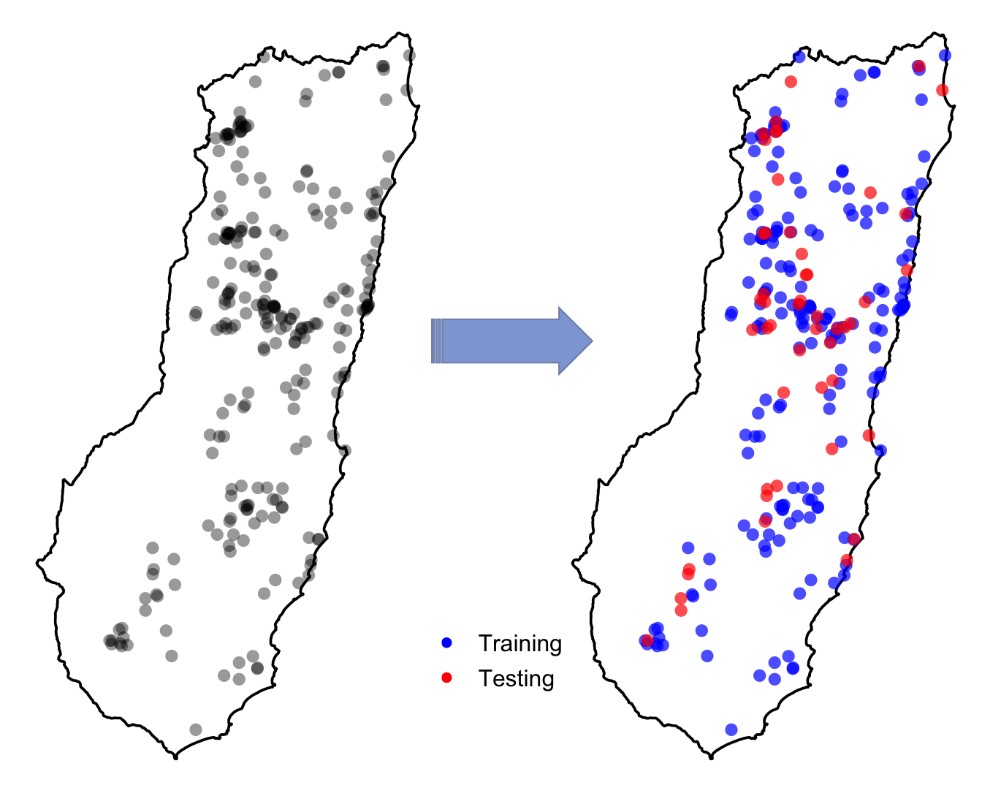
Modelling species distributions involves relating a set of species occurrences to relevant environmental variables. An important step in this process is assessing how good your model is at figuring out where your target species is. We generally do this by evaluating the predictions made for a set of locations that aren’t included in the model fitting process (the ‘testing points’).
Random splitting of the species occurrence data into training and testing points
The normal, practical advice people give about this suggests that, for reliable validation, the testing points should be independent of the points used to train the model. But, truly independent data are often not available. Instead, modellers usually split their data into a training set (for model fitting) and a testing set (for model validation), and this can be done to produce multiple splits (e.g. for cross-validation). The splitting is typically done randomly. So testing points sometimes end up located close to training points. You can see this in the figure to the right: the testing points are in red and training points are in blue. But, could this cause any problem? Continue reading “Spatial Cross-Validation of Species Distribution Models in R: Introducing the blockCV Package”
مدلسازی توزیع گونهها به تخمین و برآورد ارتباط بین مجموعهای از نقاط حضور گونه با متغیرهای زیستمحیطی مرتبط می پردازد. یکی از مراحل اساسی این فرایند، ارزیابی قدرت مدل برای پیشبینی مکانهایی است که احتمال حضورگونه در آنجا وجود دارد. این کار اغلب با ارزیابی پیشبینی انجام شده در مجموعهای ازنقاط که در فرآیند مدلسازی مورد استفاده قرار نگرفته اند (نقاط آزمایشی) صورت میگیرد.
تقسیم تصادفی دادههای حضور گونه به نقاط آزمایشی و آموزشی
مطالعات پیشین بر این نکته تاکید دارند که به منظور ارزیابی معتبر، نقاط آزمایشی باید مستقل از نقاط آموزشی باشند، این درحالیست که داده مستقل واقعی به ندرت در دسترس می باشد. به همین دلیل، در فرایند مدلسازی معمولا دادههای موجود را به دو قسمت دادههای آموزشی (برای کالیبره کردن مدل) و داده های آزمایشی (برای ارزیابی دقت مدل) تقسیم میکنند، این استراتژی میتواند چند قسمتی هم باشد (برای مثال اعتبارسنجی متقاطع یا cross-validation). از آنجاییکه این تقسیم بندی معمولا بصورت تصادفی انجام میشود، بنابراین گاهی اوقات نقاط آزمایشی در فواصل نزدیک به نقاط آموزشی قرار میگیرند. شکل زیر این مساله را به خوبی نشان می دهد که در آن نقاط آزمایشی به رنگ قرمز و نقاط آموزشی آبی هستند. اما آیا این مساله میتواند مشکلی ایجاد کند؟ Continue reading “اعتبارسنجی متقاطع مکانی در مدلسازی توزیع گونهها”
Anyone who studies social animals in the wild (or human groups, for that matter), will soon find that some individuals threaten or attack others frequently, while others try to get out of the way or signal their submission in response to aggression. Observers tally the outcome of such aggressive interactions between any given two individuals (or ‘dyads’) and try to deduce the rank hierarchy from such winner-loser matrices. One drawback of this approach is that all temporal information is lost.
Imagine Royal, a baboon, dominating over Power, another baboon, 20 times, and Power dominating over Royal 20 times as well. If we just look at these data, we might think that they have the same fighting ability and similar ranks. But, if we know that Royal beat Power the first 20 of the interactions, then Power beat Royal in all further interactions, we’d come to a totally different conclusion. We’d infer that Power had toppled Royal and a rank change had taken place.