Collecting leaves or seeds from tall trees is a difficult task that many plant physiologists, ecologists, geneticists and forest managers encounter repeatedly. In a series of videos on the Methods in Ecology and Evolution YouTube channel, Kara N. Youngentob, Christina Zdenek and Eva van Gorsel demonstrate how to use the arborist throw-line launcher, which significantly simplifies this task. This new way of collecting seeds and leaves from tall trees is explained in their Applications article ‘A simple and effective method to collect leaves and seeds from tall trees‘. As this is an Applications paper, it is freely available to everyone.
Basic Techniques for the Arborist Throw-line Launcher
The first of the three videos is a basic overview of the method. In this tutorial, the authors teach you how to find the ideal branch, how to use the throw-line launcher and go through some important safety information. Continue reading “The Arborist Throw-line Launcher”
With impact being considered more and more in promotion applications and REF-style (Research Excellence Framework) exercises, science communication is becoming an integral part of a scientist’s job. The problem is: most of us academics aren’t exactly trained in science outreach and our communication styles are heavily biased towards anything written, as opposed to anything visual.
With technological advancements constantly making things easier, however, more and more scientists are taking the plunge and adventuring into the world of YouTube and Vimeo to disseminate their work. But why are they doing so? Is it easy? Do you need expert help or can you do it yourself easily?
This blog post aims to answer all the questions and worries you may have as a scientist thinking of making a video about your work for the first time. To address these worries and questions in the most comprehensive way, we asked 12 authors who recently produced a video about their paper (in some cases their first) if they could give us some insights on their experience, and detail for us the challenges and benefits of choosing this style of communication. Their stories are the background to our story. Continue reading “A Video is Worth a Million Words: Why You Should Make a Video about YOUR Article”
The seemingly basic question of whether a population is increasing, decreasing, or stable can be one of the most difficult to answer. Collecting data on rare and elusive species is hard. Imagine trying to detect a handful of fisher or wolverine across hundreds of thousands of acres – it is physically demanding, time consuming and logistically complicated. And that’s just to do it once! To monitor a population for changes, you have to repeat these surveys regularly over many years. The long-term monitoring that is necessary for conservation requires careful planning and a substantial commitment of resources and funding. So before we spend these valuable resources, it’s critical to know whether the data we are collecting can help us to answer our questions. Continue reading “Spatially-explicit Power Analysis: A First Step for Occupancy-Based Monitoring”
This month’s issue contains two Applications articles and one Open Access article, all of which are freely available.
– CPW Photo Warehouse: freely available software that has been customized to identify, archive, and transform photographs into data formats required for statistical analyses. Users navigate a series of point-and-click menu items that allow them to input information from camera deployments, import photos and store data. Images are seamlessly incorporated into the database windows, but are stored separately.
–SIMR: An R package that allows users to calculate power for generalized linear mixed models from the lme4 package. The power calculations are based on Monte Carlo simulations. It includes tools for (i) running a power analysis for a given model and design; and (ii) calculating power curves to assess trade-offs between power and sample size.
The biggest library of bat sounds has been compiled to detect bats in Mexico – a country which harbours many of the Earth’s species and has one of the highest rates of species extinction and habitat loss.
An international team led by scientists from UCL, University of Cambridge and the Zoological Society of London, developed the reference call library and a new way of classifying calls to accurately and quickly identify and differentiate between bat species.
It is the first time automatic classification for bat calls has been attempted for a large variety of species, most of them previously noted as hard to identify acoustically. Continue reading “Biggest Library of Bat Sounds Compiled”
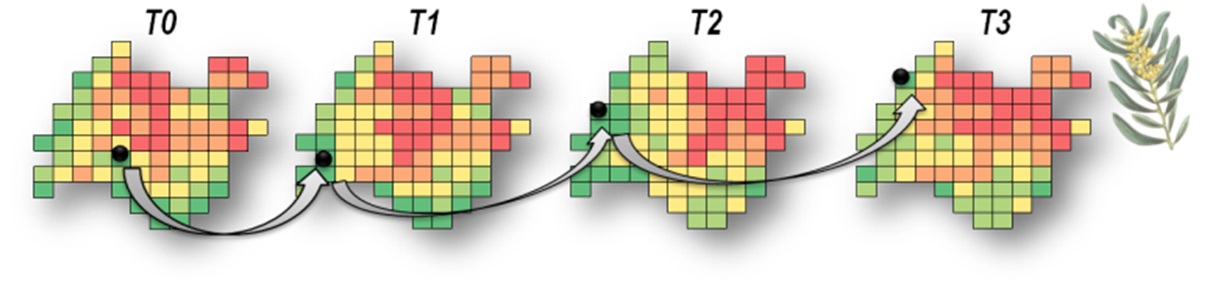
Climate change is driving many species to alter their geographic distributions. The ranges of some species contract, expand or shift as individuals track favorable climate conditions. In some cases, threatened species are moving out of protected areas. These trends are expected to intensify in the coming years.
To increase conservation effectiveness within protected areas in the future, researchers at the Research Center on Biodiversity and Genetic Resources at the University of Évora and the Department of Mathematics of the Faculty of Sciences and Technology from the NOVA University in Lisbon, Portugal, have come up with a set of modelling tools to optimize the scheduling of conservation area allocation as the climate changes. These take into account restrictions of conservation area expansion derived from the prevailing socio-economic activities. “The objective is to select the best dispersal corridors for each species considering a budget restriction or competition with other socioeconomic activities” said Diogo Alagador. “These selections are complex and non-trivial as they incorporate decisions on the spatial and temporal trends of large sets of species.”
The concept of a spatio-temporal corridor for a species in an environmental heterogeneous region.
Typically, ecology courses contain at least a day of matrix population models. So most ecologists are somewhat familiar with how simple life cycles (and complex ones) can be depicted and analysed using matrix models. Briefly, these models represent what happens to individuals over a certain time interval (do they die? do they reproduce? if so, how much?). What individuals do in the context of these models can then be used to study the dynamics of a population.
Often, individuals are classified by size in matrix models, as small individuals tend to have different survival, growth and reproduction rates than large ones. But how many classes do you need to model the dynamics of a size-structured population properly? Instead of choosing arbitrary size class boundaries, Easterling, Ellner and Dixon (2000) came up with the idea of using continuous size variables and integrals to define a population model… and that’s how the first Integral Projection Model (‘IPM’ for us friends) came to be.
Naturally, for the development of a new demographic tool to prove useful to the scientific community, it must be flexible enough to be ‘one-size-fits-all’… and the needs of ecologists, evolutionary biologists and conservation biologists – who have to date used extensively size-based matrix models – are rather variable in size, colour and shape. Continue reading “Stage-dependent Demographic Modelling at Your Finger Tips”
Invasive weeds cause environmental and economic harm around the world. Land managers bear a heavy responsibility for the control of infestations in what is often a time-consuming and costly battle.
Understanding the current and future distribution of an invasive species allows managers to better direct their limited resources. However, the direct and strategic management of weeds is tricky and that’s why population models (in particular spatial dispersal models that can be applied without much data) are needed to inform and facilitate action on the ground. Continue reading “A Model Approach to Weed Management”
“‘Why is this plant growing here?’ Tackling this question has led me through wetlands, forests, deserts and grasslands. I’ve poked at this question from the scale of plant traits all the way up to satellite imagery. I employ tools that include multivariate analysis, community and landscape diversity metrics, simulation modelling, and spatial classification. My current focus is on agricultural decision support tools for pasture and rangeland.”
Sarah will be handling Applications articles for the journal. Applications papers describe new software, equipment or other practical tools, with the intention of promoting and maximising the uptake of these new approaches. All of our published Applications articles are freely available to everyone. Continue reading “New Associate Editor: Sarah Goslee”






 Methods Blog