Today, on International Owl Awareness Day (August 4), we celebrate the research we have done to better understand owls and their prey. There are over 200 extant species of owls, a handful of which have geographic distributions spanning several continents (i.e., barn owl, snowy owl, short-eared owl, long-eared owl). So no matter where you are in the world you’re probably not too far away from an owl.
Our 5th Anniversary Special Feature is a collection of six articles (plus an Editorial from Executive Editor Rob Freckleton) that highlights the breadth and depth of topics covered by the journal so far. It grew out of our 5th Anniversary Symposium – a joint event held in London, UK and Calgary, Canada and live-streamed around the world in April 2015 – and contains papers by Associate Editors, a former Robert May prize winner and regular contributors to the journal.
The six articles are based on talks given at last May’s Symposium. They focus on:
In his Editorial for the Special Feature, Rob Freckleton looks to the future. In his words: “we hope to continue to publish a wide range of papers on as diverse a range of topics as possible, exemplified by the diversity of the papers in this feature”.
If you are attending Evolution, as well as attending the fabulous talks mentioned by Hélène below, do stop by booth 125 to see our BES colleague Simon Hoggart. Simon is the Assistant Editor of Journal of Animal Ecology and would be happy to answer your questions about any of our journals or any of the other work we do here at the BES.
RPANDA: a time machine for evolutionary biologists
Imagine “Doc”, Marty’s friend in Back to the Future, trying to travel back millions of years in an attempt to understand the history of life. Instead of building a time machine from a DeLorean sports car powered by plutonium, he could dig fossils, or more likely, he would use molecular phylogenies.
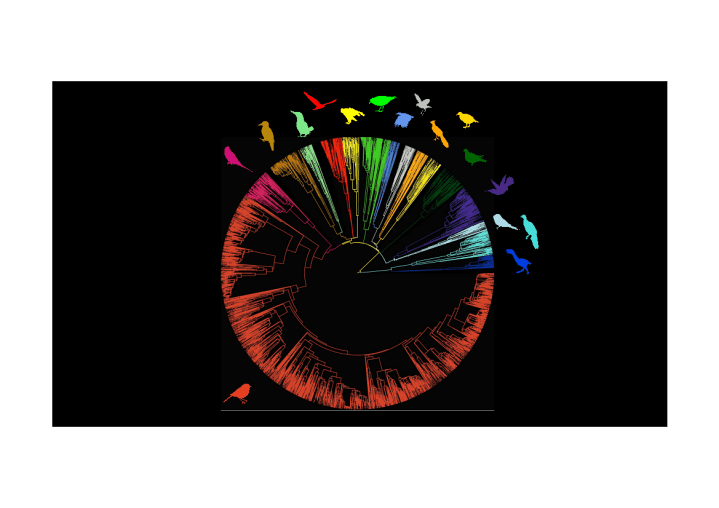
Molecular phylogenies are family trees of species that can be built from data collected today: the genes (molecules) of present-day species (Fig 1). They are often thought of as trees, in reference to Darwin’s tree of life. The leaves represent the present: species that can be found on Earth today. The branches represent the past: ancestral species, which from time to time split, giving rise to two independent species. The structure of the tree tells us which species descend from which ancestors, and when their divergence happened.
Fig 1: The phylogenetic tree of all birds (adapted from Jetz et al. 2012). Each bird order is represented by a single bird silloutter and a specific colour (the most abundant order of Passeriformes, for example is represented in dark orange). Each terminal leaf represents a present-day bird species, while internal branches represent the evolutionary relationships among these species.
Our understanding of how biological diversity works has been advanced by a long history of observing species and linking patterns to ecological processes. However, we generally don’t focus as much on those species that aren’t observed, or in other words ‘absent species’. But, can absent species provide valuable information?
To begin learning about dark diversity, there are two important terms that we need to define: ‘species pool’ and ‘focal community’. A ‘species pool’ is a set of species present in a particular region or landscape that can potentially inhabit a particular observed community because of suitable local ecological conditions.
A ‘focal community’ is the set of species that have been observed in a particular region or landscape (this is the ‘observed community’ and can also be referred to as alpha diversity). For a given focal community to become established, the species within it must have overcome dispersal pressures as well as environmental and biotic filters.
The biggest library of bat sounds has been compiled to detect bats in Mexico – a country which harbours many of the Earth’s species and has one of the highest rates of species extinction and habitat loss.
An international team led by scientists from UCL, University of Cambridge and the Zoological Society of London, developed the reference call library and a new way of classifying calls to accurately and quickly identify and differentiate between bat species.
It is the first time automatic classification for bat calls has been attempted for a large variety of species, most of them previously noted as hard to identify acoustically. Continue reading “Biggest Library of Bat Sounds Compiled”
Invasive weeds cause environmental and economic harm around the world. Land managers bear a heavy responsibility for the control of infestations in what is often a time-consuming and costly battle.
Understanding the current and future distribution of an invasive species allows managers to better direct their limited resources. However, the direct and strategic management of weeds is tricky and that’s why population models (in particular spatial dispersal models that can be applied without much data) are needed to inform and facilitate action on the ground. Continue reading “A Model Approach to Weed Management”
A species is either extant or extinct – it exists or it does not exist. Black and white, a binary choice. Surely it should not be difficult to assign species to one of these two categories? Well, in practice it can be extremely challenging and a plethora of methods have been developed to deal with the problem. This of course leads to a second challenge – which of the plethora should you use?! (More on this later…)
There are a few well-studied cases where we can assert extinction confidently. For example, the chances of the Dodo (Raphus cucullatus) having existed undetected for upwards of 300 years on an island now densely populated by humans are infinitesimally small. However, many extinctions are far harder to diagnose. Species typically become extremely rare before becoming extinct. If taxa are particularly cryptic or are found across a huge geographic range it is quite plausible that the few remaining individuals may exist undetected for decades. An extreme illustration of this is the 1938 discovery of Latimeria chalumnae, a deep-sea member of the Coelacanths, the entire order of which was believed to have become extinct 80 million years earlier! Continue reading “Inferring Extinction: When is a Species as Dead as a Dodo?”
By now we’re all familiar with the global biodiversity crisis: increasing numbers of species extinct or at risk of extinction; widespread habitat loss and a seemingly endless set of political, logistical and financial obstacles hampering swift action for conservation. The international Convention on Biological Diversity (CBD) has set twenty global diversity targets, many of which require participating nations to conduct accurate and efficient monitoring to assess their progress and inform policy decisions. Governing bodies and organizations worldwide have agreed that immediate, efficient action is essential to preserving our planet’s increasingly threatened ecosystems.
But how? Diversity measurement techniques are a tricky business. Accurately recording diversity can be time-consuming, labor-intensive, expensive, invasive and highly susceptible to human error. Often these methods involve the employment of trained specialists to individually identify hundreds or even thousands of species, a process that can take many months to complete.
Marine habitats are particularly difficult to access because of the physical limitations of humans underwater, and are often flawed due to the influence of our presence on marine organisms. However, the oceans contain many of the world’s most diverse systems, and, despite the limitations of current methods, the need to monitor marine diversity is a top priority for the global conservation movement. Continue reading “Revealing Biodiversity on Rocky Reefs using Natural Soundscapes”
To understand how species survive in nature, demographers pair field-collected life history data on survival, growth and reproduction with statistical inference. Demographic approaches have significantly contributed to our understanding of population biology, invasive species dynamics, community ecology, evolutionary biology and much more.
As ecologists begin to ask questions about demography at broader spatial and temporal scales and collect data at higher resolutions, demographic analyses and new statistical methods are likely to shed even more light on important ecological mechanisms.
Traditionally, demographers collect life history data on species in the field under one or more environmental conditions. This approach has significantly improved our understanding of basic biological processes. For example, rosette size is a significant predictor of survival for plants like wild teasel (Werner 1975 – links to all articles are at the end of the post), and desert annual plants hedge their bets against poor years by optimizing germination strategies (Gremer & Venable 2014).
Demographers also include temporal and spatial variability in their models to help make realistic predictions of population dynamics. We now know that temporal variability in carrying capacity dramatically improves population growth rates for perennial grasses and provides a better fit to data than models with varying growth rates because of this (Fowler & Pease 2010). Moreover, spatial heterogeneity and environmental stochasticity have similar consequences for plant populations (Crone 2016). Continue reading “Demography and Big Data”
 Today, on International Owl Awareness Day (August 4), we celebrate the research we have done to better understand owls and their prey. There are over 200 extant species of owls, a handful of which have geographic distributions spanning several continents (i.e., barn owl, snowy owl, short-eared owl, long-eared owl). So no matter where you are in the world you’re probably not too far away from an owl.