Senior Editor Vacancy at Methods in Ecology and Evolution

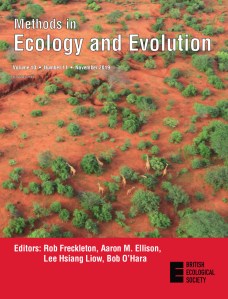
Issue 6.7_Kakadu FloodplainsThe British Ecological Society (BES) is a thriving learned society established in 1913 whose vision is a world inspired, informed and influenced by ecology. It publishes five successful journals, and a quarterly newsletter, the Bulletin, that is distributed to its 5,000 members worldwide. At present, the BES is seeking an outstanding ecologist to join the team of Senior Editors on Methods in Ecology and Evolution.

Methods in Ecology and Evolution (MEE) is a high-profile broad-scope journal which promotes the development of new methods in ecology and evolution and facilitates their dissemination and uptake by the research community. It brings together papers from previously disparate sub-disciplines to provide a single forum for tracking methodological developments in all areas. The journal has excellent citation metrics including a current Impact Factor of 6.34 and an active social media presence.

Submissions to MEE are growing and we are seeking an Senior Editor to strengthen and complement the editorial team and to continue raising the journal’s profile worldwide. The journal’s editorial team currently consists of three Senior Editors who are supported by an international board of around 60 Associate Editors and dedicated editorial office personnel. The Editors work together to determine journal strategy and to increase the reputation and quality of the journal, in addition to making decisions on around 800 manuscripts submitted each year. Further details about the Journal and its current editorial team can be found at www.methodsinecologyandevolution.org. Continue reading “Senior Editor Vacancy at Methods in Ecology and Evolution”

Issue 7.11

Issue 7.11 is now online!

The November issue of Methods is now online!

This month’s issue contains four Applications articles and two Open Access articles, all of which are freely available.

– moveHMM: This R package allows ecologists to process GPS tracking data into series of step lengths and turning angles, and to fit a hidden Markov model to these data, allowing, in particular, for the incorporation of environmental covariates.

– BORIS: An open-source and multiplatform standalone program that allows a user-specific coding environment to be set for a computer-based review of previously recorded videos or live observations. Being open to user-specific settings, the program allows a project-based ethogram to be defined that can then be shared with collaborators, or can be imported or modified.

– inbreedR: An R package that provides functions to measure variance in inbreeding – through the strength of correlation in heterozygosity across marker loci – based on microsatellite and SNP markers with associated P-values and confidence intervals. Within the framework of Heterozygosity–fitness correlation theory, inbreedR also estimates the impact of inbreeding on marker heterozygosity and fitness.

– Terrestrial Precipitation Analysis: This package is comprised of the Precipitation Trends (P-Trend), Precipitation Attributes (P-Att) and Precipitation Manipulation (P-Man) tools. Combined, these web tools allow researchers to easily calculate fundamental precipitation statistics for past, present and projected future precipitation regimes for any terrestrial location in the world.

Continue reading “Issue 7.11”

Thank You to All of Our Reviewers: Peer Review Week 2016

As many of you will already know, this week is Peer Review Week (19-25 September). Peer Review Week is a global event celebrating the vital work that is done by reviewers in all disciplines. To mark the week, we will be having a series of blog posts about peer review. The theme for this year’s Peer Review Week is recognition for review and we’re starting … Continue reading Thank You to All of Our Reviewers: Peer Review Week 2016

New Associate Editor: Marie Auger-Méthé

Today, we are pleased to be welcoming a new member of the Methods in Ecology and Evolution Associate Editor Board. Marie Auger-Méthé joins us from Dalhousie University in Canada and you can find out a little more about her below.

Marie Auger-Méthé

Marie Auger-Méthé

“I am broadly interested in developing and applying statistical tools to infer behavioural and population processes from empirical data. My work tends to focus on marine and polar mammals, but the methods I develop are often applicable to a wide range of species and ecosystems. My recent work has centred on modelling animal behaviour using movement data and I generally analyse data with spatial and/or temporal structure.”

Marie has been reviewing for Methods in Ecology and Evolution for a few years and has contributed articles to some of the other journals of the British Ecological Society too. Earlier this month, her article titled ‘Evaluating random search strategies in three mammals from distinct feeding guilds‘ was published in the Journal of Animal Ecology. Continue reading “New Associate Editor: Marie Auger-Méthé”

New Associate Editors

Today we are welcoming two new Associate Editors to Methods in Ecology and Evolution: Samantha Price (University of California, Davis, USA) and Andrés Baselga (University of Santiago de Compostela, Spain). Samantha Price “My research seeks to answer the question ‘What regulates biodiversity?’. I use phylogenetic and comparative methods to investigate the abiotic and biotic drivers of global patterns of ecomorphological and lineage diversity over long periods of time and across … Continue reading New Associate Editors

Meet the Team at ESA 2016

Post provided by EMILIE AIMÉ, Managing Editor, Methods in Ecology and Evolution This year’s annual ESA meeting is fast approaching. It’s in Fort Lauderdale, Florida and I’ll be heading across the pond, along with Catherine Hill, our Head of Publications, and Hazel Norman, our Executive Director, to chat to delegates about Methods in Ecology and Evolution, as well as our other journals and the British … Continue reading Meet the Team at ESA 2016

Issue 7.6: Methods in Ecology and Evolution 5th Anniversary Special Feature

Issue 7.6 is now online!

The June issue of Methods, which includes our latest Special Feature – “5th Anniversary of Methods in Ecology and Evolution” – is now online!

Our 5th Anniversary Special Feature is a collection of six articles (plus an Editorial from Executive Editor Rob Freckleton) that highlights the breadth and depth of topics covered by the journal so far. It grew out of our 5th Anniversary Symposium – a joint event held in London, UK and Calgary, Canada and live-streamed around the world in April 2015 – and contains papers by Associate Editors, a former Robert May prize winner and regular contributors to the journal.

The six articles are based on talks given at last May’s Symposium. They focus on:

In his Editorial for the Special Feature, Rob Freckleton looks to the future. In his words: “we hope to continue to publish a wide range of papers on as diverse a range of topics as possible, exemplified by the diversity of the papers in this feature”.

All of the articles in the Special Feature will be freely available for a limited time. In addition to this, two of the articles (Shedding light on the ‘dark side’ of phylogenetic comparative methods and Perturbation analysis of transient population dynamics using matrix projection models) are Open Access.
Continue reading “Issue 7.6: Methods in Ecology and Evolution 5th Anniversary Special Feature”

RPANDA: A Time Machine for Evolutionary Biologists

Post provided by HÉLÈNE MORLON

Yesterday saw the start of this year’s annual Evolution meeting and to celebrate Hélène Morlon has written a blog post discussing the amazingly versatile RPANDA package that she is developing with her research group. A description of RPANDA was published in the journal earlier this year and, like all our Applications papers, is freely available to read in full.

If you are attending Evolution, as well as attending the fabulous talks mentioned by Hélène below, do stop by booth 125 to see our BES colleague Simon Hoggart. Simon is the Assistant Editor of Journal of Animal Ecology and would be happy to answer your questions about any of our journals or any of the other work we do here at the BES.

RPANDA: a time machine for evolutionary biologists

Imagine “Doc”, Marty’s friend in Back to the Future, trying to travel back millions of years in an attempt to understand the history of life. Instead of building a time machine from a DeLorean sports car powered by plutonium, he could dig fossils, or more likely, he would use molecular phylogenies.

Molecular phylogenies are family trees of species that can be built from data collected today: the genes (molecules) of present-day species (Fig 1). They are often thought of as trees, in reference to Darwin’s tree of life. The leaves represent the present: species that can be found on Earth today. The branches represent the past: ancestral species, which from time to time split, giving rise to two independent species. The structure of the tree tells us which species descend from which ancestors, and when their divergence happened.

birds_phylog
Fig 1: The phylogenetic tree of all birds (adapted from Jetz et al. 2012). Each bird order is represented by a single bird silloutter and a specific colour (the most abundant order of Passeriformes, for example is represented in dark orange). Each terminal leaf represents a present-day bird species, while internal branches represent the evolutionary relationships among these species.

Continue reading “RPANDA: A Time Machine for Evolutionary Biologists”

New Associate Editor: Will Pearse

Today, we are pleased to be welcoming a new member of the Methods in Ecology and Evolution Associate Editor Board. Will Pearse joins us from McGill University in Canada and you can find out a little more about him below. Will Pearse “I am an evolutionary ecologist and use phylogeny to link the evolution of species’ traits with their ecological community assembly. I’m interested in phylogenetic methods, macro-evolution of species’ traits, community assembly … Continue reading New Associate Editor: Will Pearse