Post provided by A. Murat Maga
Picture a graduate student who has just spent eighty hours tracing the individual bones of a fish skull, slice by slice, through a high-resolution microCT scan. The result is a beautiful, richly labelled 3D dataset. And then? Too often it lands on a hard drive, or gets flattened into a static 3D model that no one else can edit, correct or build upon. We have all watched it happen. Raw scans have never been easier to share — but the slow, expert work of turning a grey volume into labelled anatomy is exactly where collaboration grinds to a halt.
This is the “last mile” problem of digital morphology, and it is the reason we built MorphoDepot.
The bottleneck isn’t the scan — it’s everything after it
Over the past two decades, computed tomography (CT), magnetic resonance imaging (MRI) and surface scanning have transformed how we study organismal form. We can capture fragile fossils and rare museum specimens in exquisite three-dimensional detail without ever touching them. Repositories such as MorphoSource have done a wonderful job of making these raw scans findable and citable.
But a scan is only the starting point. The real scientific value appears when an expert performs segmentation: the painstaking process of labelling each structure, voxel by voxel, turning an undifferentiated volume into an annotated atlas. That work is laborious, demands deep anatomical knowledge, and — crucially — tends to get trapped. Finished segmentations are usually deposited as fixed, often proprietary, “finished products”. Errors can’t easily be corrected, alternative interpretations can’t be proposed and discussed, and a dataset can’t evolve as terminology or understanding changes. The social heart of science — review, debate, iteration — is effectively designed out.
It gets harder still in the classroom. Letting students segment real specimens is a fantastic way to teach both anatomy and technical skill, but coordinating files, software, real-time collaboration and assignment tracking can be daunting.
Software engineering solved this problem years ago
Here is the idea that started it all for us: the open-source software world wrestled with an almost identical challenge — how do thousands of strangers improve a shared, complex thing without stepping on each other — and largely solved it with the fork-and-contribute model.
Anyone can take their own independent copy of a project (a fork), work on it safely, and then propose their changes back through a pull request (PR) that a maintainer reviews before merging. Every edit is attributed, timestamped and explained. Nothing enters the official version without review. We realised that a segmented anatomical dataset is, structurally, just another collaborative project — so why not manage it the same way?
MorphoDepot is our answer. It connects the collaborative machinery of GitHub and the Git version-control system to the open-source 3D Slicer platform and its SlicerMorph extension. Each specimen becomes a repository that can be forked, segmented, reviewed and merged — and the whole workflow is driven from inside Slicer, so contributors barely have to touch the command line.
How it works in practice
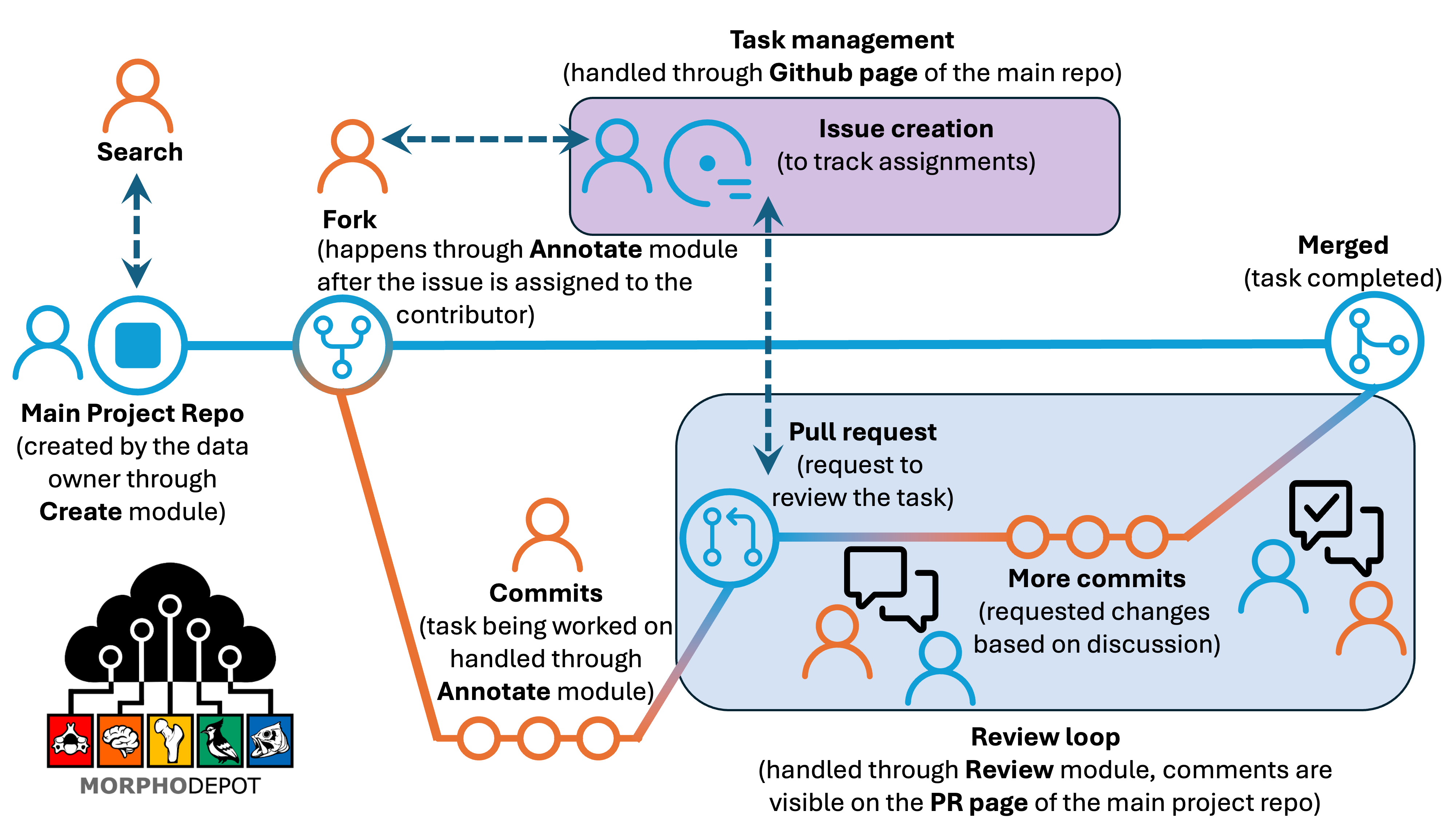
A project owner, such as an instructor or a lab head, creates a repository from three things: a prepared scan, a colour table that maps agreed anatomical terms to a standard ontology such as UBERON, and the specimen’s metadata. A contributor then opens an issue asking to segment a particular structure. Once assigned, MorphoDepot quietly forks the repository to their own account, they do the segmentation in Slicer’s Segment Editor, and they “commit” their progress every 20–30 minutes — automatic save points that also become a complete, auditable history of the work. When they’re done, they open a pull request; the owner downloads the proposed segmentation as an overlay, inspects it, and either requests changes or approves and merges it. The result answers questions we usually can’t: Who segmented the parietal bone, when, and why did they draw the boundary there?
The same workflow handles soft tissue and model organisms just as well as bone. One MorphoDepot project, for instance, is an averaged embryonic day 15 (E15) mouse embryo atlas built from contrast-enhanced microCT, in which contributors segment developing internal organs rather than the skeleton. It is exactly the kind of standardised reference that developmental biology and birth-defect research increasingly depend on.
Why it matters
By standardising on open tools and the open NRRD label format, MorphoDepot breaks the toolchain lock-in that has long trapped segmented data. For education, students become creators of scholarly resources rather than passive consumers, and remote or hybrid teaching genuinely works — an instructor can review work happening across several time zones. For research, a palaeontologist in Germany and one in Japan can co-segment the same holotype without shipping a fragile fossil anywhere. And for AI, the community can finally co-create the large, consistently labelled, version-controlled training datasets that automated segmentation has been starving for — embodying the FAIR (Findable, Accessible, Interoperable, Reusable) principles along the way.
And while we built MorphoDepot as a 3D Slicer extension to give one polished, end-to-end experience, nothing about the approach is tied to Slicer. The workflow rests entirely on open standards — Git, the NRRD format, established ontologies — so any other tool, including a web-based one, can join in, provided it reads and writes the same open formats. The model is the point; Slicer is simply how we deliver it today.
We’re now working towards a GitHub Organization model with team-based governance and shared cloud storage to lift the current file-size limit, plus a Release tab for minting citable, versioned datasets.
Try it
The project now has a home at morphodepot.org, which is the best single place to follow the latest news, releases and newly shared repositories. From there, MorphoDepot installs with one click via the 3D Slicer Extension Manager, and there is a step-by-step tutorial to get you started. If you’d rather not install anything, you can run the whole thing in a browser through a free MorphoCloud On Demand instance. Community colour tables for various organisms live here.
We’d love for you to fork an anatomy, propose a change, and help turn our static archives into living, community-curated atlases. Come and follow us along at morphodepot.org, and consider joining one of our training events.
Read the full paper here.
A. Murat Maga (University of Washington & Seattle Children’s Research Institute) and Steve Pieper (Isomics, Inc.) are the joint first authors of the paper, with co-authors Cassandra Donatelli, Paul M. Gignac, Matthew Kolmann, Christopher Noto, Adam Summers and Natalia Taft. MorphoDepot is supported by the US National Science Foundation (DBI/2301405).

