This year is our 10th Anniversary! To celebrate, we’ve made a timeline of highlights from the past decade, from the first paper ever submitted, to a top-cited article with 3,295 citations. We’d like to give a big thanks our dedicated editors, plus all the authors and reviewers who are developing the fields of ecology and evolution with groundbreaking new methods. Here’s to 10 more years! Continue reading Happy 10th Anniversary to us!
A central component of an organism’s fitness is its ability to successfully reproduce. This includes finding a potential mate and successful mating. For plants, movement of pollen from an anther to a conspecific stigma is essential for successful reproduction, but directly tracking movement of individual pollen grains heretofore has been impossible (with the exception of those species of orchids and milkweeds whose pollen comes in large packages (pollinia)). Knowing how pollen move around, whether or not they successfully fertilize ovules, is also central to understanding the evolution and ecology of flowering plants (angiosperms) and floral traits.
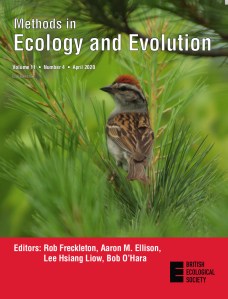
The latest issue of Methods in Ecology and Evolution is now online! This month’s issue is a little shorter than our last few. But, as they say, good things come in small packages!
Senior Editor Lee Hsiang Liow has selected six Featured Articles this month. You can find out about all of them below. We’ve also got five Applications articles and a Practical Tools article in the April issue that we’re going to cover. Those six papers are freely available to everyone – no subscription required!
The latest issue of Methods in Ecology and Evolution is now online! This month’s issue is a little shorter than our last few. But, as they say, good things come in small packages!
Executive Editor Aaron Ellison has selected six Featured Articles this month. You can find out about all of them below. We’ve also got five Applications articles in the March issue that we’re going to cover.
Each year Methods in Ecology and Evolution awards the Robert May Prize to the best paper in the journal by an author at the start of their career. Today we present the shortlisted papers for 2019’s award, based on articles published in volume 10 of the journal. The winner will be chosen by the journal’s Senior Editors in a few weeks. Keep an eye on the blog … Continue reading 2019 Robert May Early Career Researcher Prize Shortlist
Executive Editor Rob Freckleton has selected six Featured Articles this month. You can find out about all of them below. We’ve also got six Applications articles and five Open Access articles in the February issue – we’ll talk about all of those here too.
We’re starting 2020 with a great issue – and ALL of the articles are completely free. And they’ll remain free for the whole year. No subscription required.
You can find out more about our Featured Articles (selected by the Senior Editor) below. We also discuss this month’s Open Access, Practical Tools and Applications articles. There are also articles on species distributions, biotic interactions, taxonomic units and much more.
Methods in Ecology and Evolution is turning 10 years old! Back in 2010, we launched the journal because of feedback from the community that there was a need for a journal that promoted the publication of new methods. Founding Editor Rob Freckleton and Graziella Iossa (now a member of the Editorial Board) summarised the aims and ambitions for the journal in the first issue. They … Continue reading Ten Years of Methods in Ecology and Evolution
Today, we are pleased to announce the latest new member of the Methods in Ecology and Evolution Associate Editor Board. Saras Windecker joins us from the University of Melbourne, Australia as an Applications Editor. You can find out a little more about her below.
Saras Windecker
“I’m a quantitative ecologist who started out as a wetland ecologist. I’m interested in developing and applying models for a range of applied and theoretical questions, spanning decomposition, species distributions, and more recently, public health forecasting. I’m interested in software development for scientists and thinking about how we develop literate programming skills and promote open science in ecology.” Continue reading “New Associate Editor: Saras Windecker”
Hello! This is my first post as Blog Editor for Methods in Ecology and Evolution and I’m thrilled to be starting with an exciting, thought-provoking topic in the wake of Halloween. But first, let me introduce myself. I currently work as a Postdoctoral Fellow and Project Manager in the Hajibabaei Lab at the Centre for Biodiversity Genomics (University of Guelph, ON, Canada) and my undergraduate and postgraduate degrees are both from Swansea University (UK). My research background is largely focused around the application of environmental DNA (i.e. free DNA found in natural environments) to detect and monitor aquatic species and answer ecological questions through both single-species detection and DNA metabarcoding.