Field Work on a Shoestring: Using Consumer Technology as an Early Career Researcher

Post provided by CARLOS A. DE LA ROSA

Esta entrada de blog también está disponible en español

Champagne Tastes on a Beer Budget

Freshly outfitted with a VACAMS camera and GPS unit, #1691 heads off into the forest with her calf. ©Carlos A. de la Rosa

There’s a frustrating yin and yang to biological research: motivated by curiosity and imagination, we often find ourselves instead defined by limitations. Some of these are fundamental human conditions. The spectrum of light detectable by human eyes, for example, means we can never see a flower the way a bee sees it. Others limitations, like funding and time, are realities of modern-day social and economic systems.

Early career researchers (ECRs) starting new projects and delving into new research systems must be especially creative to overcome the odds. Large grants can be transformative, giving a research group the equipment and resources to complete a study, but they’re tough to get. Inexperienced ECRs are at a disadvantage when competing against battle-hardened investigators with years of grant writing experience. Small grants of up to about $5000 USD, on the other hand, are comparatively easy to find. So, how can ECRs make the most of small, intermittent sources of funding?

I found myself faced with this question in the second year of my PhD field work. Continue reading “Field Work on a Shoestring: Using Consumer Technology as an Early Career Researcher”

Trabajo de Campo a lo Barato: Uso de Tecnología de Productos de Consumo Para un Investigador al Inicio de su Carrera de Investigación

Contribución de CARLOS A. DE LA ROSA

This blog post is available in English

Gusto por champaña con presupuesto de cerveza

Recientemente equipada con una unidad de cámara y GPS VACAMS, la vaca No. 1691 se dirige al bosque con su becerro. ©Carlos A. de la Rosa

Hay un frustrante toma-y-dame en el campo de la investigación biológica: motivados por la curiosidad y la imaginación, a menudo nos encontramos definidos por limitaciones. Algunas de estas, como nuestros sentidos, son condiciones humanas fundamentales. El espectro de luz detectable por los ojos humanos, por ejemplo, significa que nunca podremos ver a una flor de la misma forma en que la ve una abeja. Otras limitaciones, como financiamiento y tiempo, representan las realidades de los sistemas sociales y económicos de hoy día.

Los investigadores al comienzo de sus carreras (Early Career Researchers, o ECRs en sus siglas en inglés) que se embarcan en nuevos proyectos y se involucran con sistemas nuevos de investigación deben ser especialmente creativos para poder superar las probabilidades. Una generosa beca puede ser transformativa, pero un ECR con poca experiencia está en desventaja cuando compite con investigadores ya endurecidos por la batalla, quienes tienen años de experiencia escribiendo propuestas de financiamiento. Por otra parte, las pequeñas becas en el rango de $2.000 a $5.000 son comparativamente fáciles de encontrar. ¿Cómo puede un ECR aprovechar al máximo estas pequeñas e intermitentes fuentes de financiamiento?

En el segundo año del trabajo de campo de mi doctorado me enfrenté con este enigma. Continue reading “Trabajo de Campo a lo Barato: Uso de Tecnología de Productos de Consumo Para un Investigador al Inicio de su Carrera de Investigación”

‘Eavesdropping’ Technology used to Protect one of New Zealand’s Rarest Birds

Below is a press release about the Methods in Ecology and Evolution article ‘A novel method for using ecoacoustics to monitor post‐translocation behaviour in an endangered passerine‘ taken from the Zoological Society of London.

Juvenile hihi. ©ZSL
Juvenile hihi. ©ZSL

Scientists from international conservation charity ZSL (Zoological Society of London), Imperial College London and conservationists from the Rotokare Scenic Reserve Trust used acoustic monitoring devices to listen in on the ‘conversations’ of New Zealand’s endemic hihi bird, allowing them to assess the success of the reintroduction without impacting the group.

For the first time ZSL scientists were able to use the calls of a species as a proxy for their movement. A happy hihi call sounds like two marbles clanging together in what is known as the ‘stitch’ call. Scientists saw the calls change from an initial random distribution to a more settled home range – marking the hihi reintroduction and the new method a success. Continue reading “‘Eavesdropping’ Technology used to Protect one of New Zealand’s Rarest Birds”

Advances in Modelling Demographic Processes: A New Cross-Journal Special Feature

Analysis of datasets collected on marked individuals has spurred the development of statistical methodology to account for imperfect detection. This has relevance beyond the dynamics of marked populations. A couple of great examples of this are determining site occupancy or disease infection state.

EURING Meetings

The regular series of EURING-sponsored meetings (which began in 1986) have been key to this development. They’ve brought together biological practitioners, applied modellers and theoretical statisticians to encourage an exchange of ideas, data and methods.

This new cross-journal Special Feature between Methods in Ecology and Evolution and Ecology and Evolution, edited by Rob Robinson and Beth Gardner, brings together a collection of papers from the most recent EURING meeting. That meeting was held in Barcelona, Spain, 2017, and was hosted by the Museu de Ciènces Naturals de Barcelona. Although birds have provided a convenient focus, the methods are applicable to a wide range of taxa, from plants to large mammals. Continue reading “Advances in Modelling Demographic Processes: A New Cross-Journal Special Feature”

Map of Chemicals in Jellyfish Could be the Future to Protecting UK Waters and Marine Life

Below is a press release about the Methods in Ecology and Evolution article ‘Spatial models of carbon, nitrogen and sulphur stable isotope distributions (isoscapes) across a shelf sea: An INLA approach‘ taken from the University of Southampton.

Jellyfish opportunistically caught in UK waters are used to map chemical variations across marine space. ©University of Southampton

Scientists at the University of Southampton have developed maps of chemicals found in jellyfish which could offer a new tool for conservation in British waters and fisheries. The maps will also be able to detect fraudulently labelled food in retail outlets by helping to trace the origins of seafood.

The Southampton based research team including Dr Clive Trueman, Dr Katie St. John Glew and Dr Laura Graham, built maps of the chemical variations in jellyfish caught in an area of approximately 1 million km2 of the UK shelf seas. These chemical signals vary according to where the fish has been feeding due to differences in the marine environment’s chemistry, biology and physical processes. Continue reading “Map of Chemicals in Jellyfish Could be the Future to Protecting UK Waters and Marine Life”

Limitations and Benefits of the Unmatched Count Technique: Considering How We Use New Methods in Conservation

Post provided by Amy Hinsley and Ana Nuno

Esta publicação no blogue também está disponível em português

A New Conservation Toolbox

It is widely accepted that many conservation challenges are directly related to human behaviour. Whether it is the over-collection of a rare orchid by harvesters in Southeast Asia, or the decisions by collectors in Europe to buy and smuggle these orchids home, understanding the extent and nature of these behaviours is essential to addressing the threats they might cause. This has led conservation researchers and practitioners to start looking outside of their discipline, to find methods and approaches from across the social sciences to improve our understanding of these complex issues.

A research assistant carrying out a UCT survey about the use of Traditional Medicine products containing bear bile in China. © Chen Haochun.

While this interdisciplinarity is a positive move for conservation, it is important that we treat these ‘new’ methods carefully and understand their limitations. If we don’t, there is a risk that our new toolbox full of exciting methods that sound great on a funding application, may in fact not be making what we do any better, or in extreme cases they may even be making it worse.

With this in mind, a group of conservation social scientists, led by researchers at the Universities of Oxford and Exeter, decided to look in depth into one of these ‘new’ methods, to provide recommendations on when and how it should be used, and when it shouldn’t. Our Open Access article – ‘Asking sensitive questions using the unmatched count technique: Applications and guidelines for conservation‘ – looks at the Unmatched Count Technique (UCT – also called the list experiment), which is increasingly being used in conservation to ask questions about ‘sensitive’ topics. Continue reading “Limitations and Benefits of the Unmatched Count Technique: Considering How We Use New Methods in Conservation”

Limitações e benefícios da técnica de contagem de itens: considerações sobre o uso de novos métodos em Conservação

publicação no blogue FORNECIDO POR AMY HINSLEY E ANA NUNO

This blog post is also available in English

Novas ferramentas de conservação

Muitos desafios em conservação estão diretamente relacionados com o comportamento humano. Quer seja a recolha excessiva de uma orquídea rara no Sudeste Asiático, ou a compra e contrabando dessas orquídeas por colecionadores na Europa, entender a magnitude e a natureza desses comportamentos é essencial para lidar com as ameaças que eles podem causar. Isso levou os investigadores e profissionais da área de conservação a começarem a olhar para fora da sua própria disciplina, de modo a encontrar métodos e abordagens das ciências sociais para melhorar a nossa compreensão sobre estas questões complexas.

Assistente de investigação a realizar um estudo recorrendo a TCI sobre o uso de produtos de medicina tradicional com bílis de urso na China. © Chen Haochun.

Embora esta interdisciplinaridade seja um passo positivo para a conservação, é importante tratar esses “novos” métodos com cuidado e entender as suas limitações. Se não o fizermos, existe o risco da nossa nova caixa de ferramentas, repleta de métodos interessantes que soam bem em candidaturas a financiamento, na verdade não melhorar aquilo que nós geralmente já fazemos ou, em casos extremos, até piorá-lo.

Tendo isto em conta, um grupo de cientistas sociais em conservação, liderado por investigadores das Universidades de Oxford e Exeter, decidiu examinar em profundidade um desses “novos” métodos, fornecer recomendações sobre quando e como ele deveria ser usado, e quando não deveria. O artigo, disponível gratuitamente na revista científica Methods in Ecology and Evolution nesta semana, examina a Técnica de Contagem de Itens (TCI), que tem sido cada vez mais usada em conservação para fazer perguntas sobre tópicos “sensíveis”. Continue reading “Limitações e benefícios da técnica de contagem de itens: considerações sobre o uso de novos métodos em Conservação”

How to Assemble, Fill and Clean Metapopulation Microcosm Plates: Two Video Tutorials

Metapopulation Microcosm Plates (MMP) are devices which resemble 96-well microtiter plates in size and shape, but with corridors connecting the wells in any configuration desired. They can be used to culture microbial metapopulations or metacommunities with up to 96 habitat patches.

In these two video tutorials, Helen Kurkjian explains how you can assemble, fill and clean MMPs in your lab.

Continue reading “How to Assemble, Fill and Clean Metapopulation Microcosm Plates: Two Video Tutorials”

Spatial Cross-Validation of Species Distribution Models in R: Introducing the blockCV Package

Post provided by Roozbeh Valavi

این پست به فارسی موجود است

Modelling species distributions involves relating a set of species occurrences to relevant environmental variables. An important step in this process is assessing how good your model is at figuring out where your target species is. We generally do this by evaluating the predictions made for a set of locations that aren’t included in the model fitting process (the ‘testing points’).

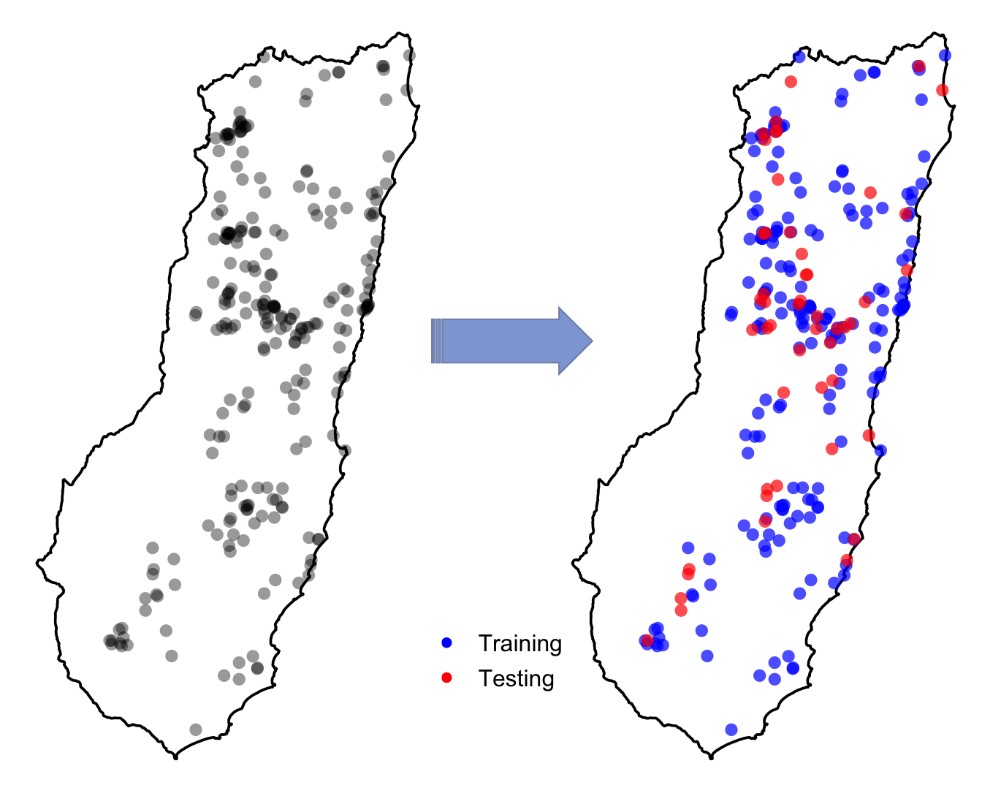
Random splitting of the species occurrence data into training and testing points

The normal, practical advice people give about this suggests that, for reliable validation, the testing points should be independent of the points used to train the model. But, truly independent data are often not available. Instead, modellers usually split their data into a training set (for model fitting) and a testing set (for model validation), and this can be done to produce multiple splits (e.g. for cross-validation). The splitting is typically done randomly. So testing points sometimes end up located close to training points. You can see this in the figure to the right: the testing points are in red and training points are in blue. But, could this cause any problem? Continue reading “Spatial Cross-Validation of Species Distribution Models in R: Introducing the blockCV Package”

اعتبارسنجی متقاطع مکانی در مدلسازی توزیع گونه‌‌ها

نویسنده: روزبه وَلَوی

This post is available in English

مدلسازی توزیع گونه‌ها به تخمین و برآورد ارتباط بین مجموعه‌ای از نقاط حضور گونه با متغیرهای زیست‌محیطی مرتبط می پردازد. یکی از مراحل اساسی این فرایند، ارزیابی قدرت مدل برای پیش­بینی مکان‌هایی است که احتمال حضورگونه در آنجا وجود دارد. این کار اغلب با ارزیابی پیش­بینی انجام شده در مجموعه‌ای ازنقاط که در فرآیند مدلسازی مورد استفاده قرار نگرفته اند (نقاط آزمایشی) صورت می‌گیرد.

تقسیم تصادفی داده‌های حضور گونه به نقاط آزمایشی و آموزشی

مطالعات پیشین بر این نکته تاکید دارند که به منظور ارزیابی معتبر، نقاط آزمایشی باید مستقل از نقاط آموزشی باشند، این درحالیست که داده مستقل واقعی به ندرت در دسترس می باشد. به همین دلیل، در فرایند مدلسازی معمولا داده‌های موجود را به دو قسمت داده‌های آموزشی (برای کالیبره کردن مدل) و داده های آزمایشی (برای ارزیابی دقت مدل) تقسیم می‌کنند، این استراتژی می‌تواند چند قسمتی هم باشد (برای مثال اعتبارسنجی متقاطع یا cross-validation). از آنجاییکه این تقسیم بندی معمولا بصورت تصادفی انجام می‌شود، بنابراین گاهی اوقات نقاط آزمایشی در فواصل نزدیک به نقاط آموزشی قرار می‌گیرند. شکل زیر این مساله را به خوبی نشان می دهد که در آن نقاط آزمایشی به رنگ قرمز و نقاط آموزشی آبی هستند. اما آیا این مساله می‌تواند مشکلی ایجاد کند؟ Continue reading “اعتبارسنجی متقاطع مکانی در مدلسازی توزیع گونه‌‌ها”