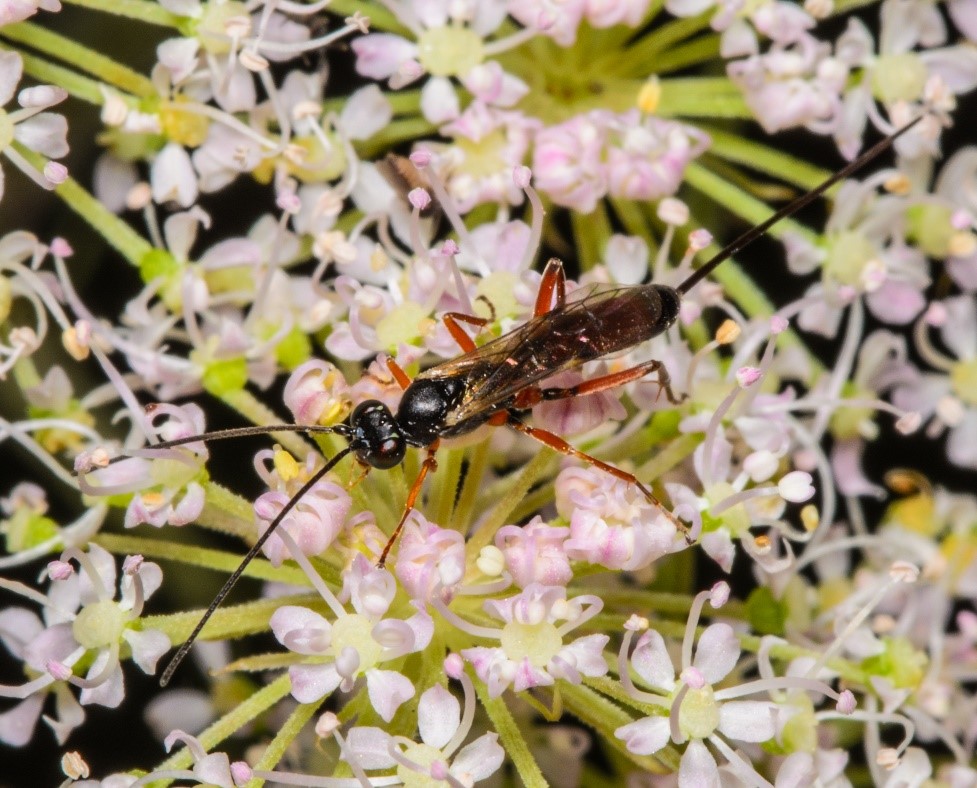
MEDI can be applied to a broad range of small invertebrate specimens, including parasitoid wasps. Credit: Jordan Cuff.
Are you kept awake at night wondering how you would measure the macronutrient content of small invertebrates? Perhaps you have tried but are haunted by the disappointment that you have had to rely on conversion factors, analogues and pooled samples. Get ready to sleep soundly, entomological entrepreneur!
In this blog post, Jordan Cuff and Maximillian Tercel will discuss their latest study published in Methods in Ecology and Evolution, concerning their brand-new method for measuring macronutrient content in invertebrates: MEDI.
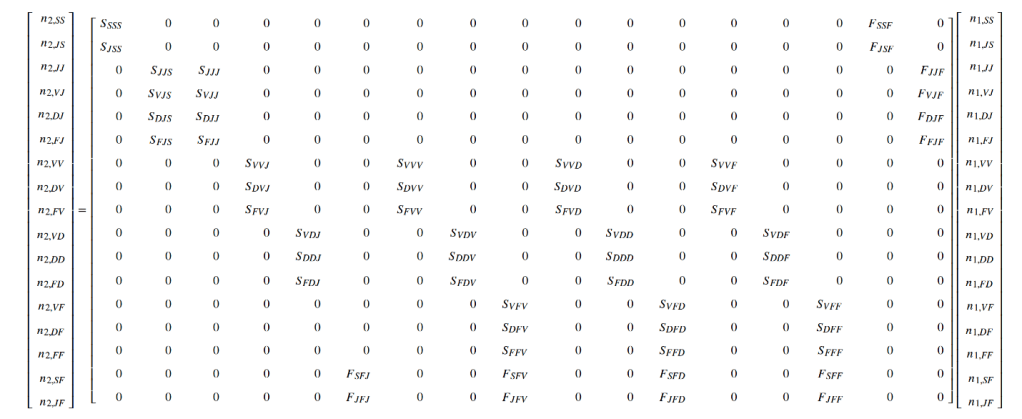
A single time-step projection of a historical matrix projection model (hMPM), for a 7 life stage life history model of Cypripedium parviflorum, the small yellow lady’s slipper. In this case, the vector of biologically plausible stage pairs in time 2 is equal to the full projection matrix multiplied by the vector of biologically plausible stage pairs in time 1.
Matrix projection modeling is a mainstay of population ecology. Ecologists working in natural area management and conservation, as well as in theoretical and academic realms such as the study of life history evolution, develop and use these models routinely. Matrix projection models (MPMs) have advanced dramatically in complexity over the years, originating from age-based and stage-based matrix models parameterized directly from the data, to complex matrices developed from statistical models of vital rates such as integral projection models (IPMs) and age-by-stage models. We consider IPMs to be a class of function-based MPM, while age-by-stage MPMs may be raw or function-based, but are typically the latter due to a better ability to handle smaller dataset. The rapid development of these methods can leave many feeling bewildered if they need to use these methods but lack sufficient understanding of scientific programming and of the background theory to analyze them properly.
Senior Editor Bob O’Hara has selected five Featured Articles this month, including methods for predicting pollinator abundance, evaluating species distribution modelling applications and accelerating image‐based ecological surveys using interactive machine learning – find out about all of them below.
We also have 12 articles that are free to read, including five Applications and two Practical Tools articles – no subscription required!
Understanding interactions between predators and prey is of interest to a variety of research fields. These interactions not only hold valuable information about ecological dynamics and food webs but are also crucial in understanding the evolution of predatory and anti-predator traits such as vision, visual signals and behavior. Thus, the “who attacks what and why” is key to approach broad evolutionary and ecological questions.
Aquatic animal telemetry has revolutionized our understanding of the behaviour of aquatic animals. One of the important advantages of telemetry methods, including acoustic telemetry, is that they provide information at the individual level. This is very relevant because it enables investigating the natural variability in behaviour within populations (like here or here), but also because one can investigate what happens to each individual animal and relate it to its natural behaviour. Knowing “what happens to each individual” is normally referred to as “fate” and it can take many forms: some fish may end-up eaten by predators, other may be fished, some of them may disperse, etc. Knowing the fate of each individual fish is crucial as it links ecological processes at the individual level to evolutionary outcomes at the population level.
Senior Editor Aaron Ellison has selected six Featured Articles this month. You can find out about all of them below. We also have eight Applications articles and seven Practical Tools articles in the November issue that are freely available to everyone – no subscription required!
We have a larger issue of 14 articles this month, featuring methods for individual bird recognition, zooplankton sampling, coral health assessment and much more.
Senior Editor Lee Hsiang Liow has selected five featured articles – find out about them below. We also have three Applications, three Practical Tools articles and 11 articles that are freely available to everyone – no subscription required!