Unde Venis Species? RRphylogeography, a new accurate method finds the area of origin of species

Post provided by Pasquale Raia (he/him), Alessandro Mondanaro (he/him) and Silvia Castiglione (she/her) Quo Vadis? Latin for Where Are You Going? was a huge 1951 box office hit produced by Metro Goldwyn Mayer. The film (which is based on an 1896 book wrote by the Polish novelist Henryk Sienkiewicz) was set in ancient Rome during Nero’s reign and is credited for saving MGM from bankruptcy … Continue reading Unde Venis Species? RRphylogeography, a new accurate method finds the area of origin of species

Early career research: Increasing access, reproducibility and transparency in phylogenetic analyses with Cristian Román-Palacios

I was born in the Colombian Andes (Armenia, Quindío) back in the 90s. I received my bachelor’s degree in Biology from Universidad del Valle, in Cali, Colombia, in 2015. I moved to the US in 2016 to pursue a Ph.D. in Ecology and Evolutionary Biology at the University of Arizona – a degree that I completed in Fall of 2020. Although my research interests seem … Continue reading Early career research: Increasing access, reproducibility and transparency in phylogenetic analyses with Cristian Román-Palacios

September 2022 Issue Out Now!

Our September issue is now online! This issue contains 22 articles about the latest methods in ecology and evolution, including methods for using the US National Ecological Observatory Network (NEON), measuring understory vegetation structure, inducing cancer in invertebrates and much more! Read on to find out about this month’s featured articles and the article behind our magical marine cover. National Ecological Observatory Network (NEON) In this … Continue reading September 2022 Issue Out Now!

July 2022 Issue Out Now!

Our July Issue is now online! This issue contains 20 articles about the latest methods in ecology and evolution, including methods for characterising soil bacterial biodiversity, identifying fish species in fish markets using eDNA, standarising and cleaning biodiversity data and much more! Plus, read the editorial about our switch to a gold open access model this month. Read on to find out about this month’s featured articles … Continue reading July 2022 Issue Out Now!

A new graphical interface and toolkit for phylogenetic analyses

Post provided by Daniel Edler

Each year Methods in Ecology and Evolution awards the Robert May Prize to the best paper published in the journal by an author at the start of their career. Ten Early Career Researchers made the shortlist for this year’s prize, including Daniel Edler who is a PhD student at Umeå University in Sweden. In this interview, Daniel shares insights on his paper ‘raxmlGUI2.0: a graphical interface and toolkit for phylogenetic analyses using RAxML’.

Continue reading “A new graphical interface and toolkit for phylogenetic analyses”

February Issue Out Now

Our February issue is now online! Our second issue of the year contains 22 high-quality articles about the latest methods in ecology and evolution. This month we have methods for visualising the tree of life, estimating arthropod abundance and diversity, disentangling effects of climate and land use on biodiversity and much more! This issue also contains four Applications and two Practical Tools articles that are free to … Continue reading February Issue Out Now

10th Anniversary Volume 3: paleotree: A Retrospective

Post provided by David bapst

To celebrate the 10th Anniversary of the launch of Methods in Ecology and Evolution, we are highlighting an article from each volume to feature on the Methods.blog. For Volume 3, we have selected ‘paleotree: an R package for paleontological and phylogenetic analyses of evolution‘ by David W. Bapst (2012). In this post, David discusses the background to the Application he wrote as a graduate student, and how the field has changed since.

I was a fourth year graduate student when I first had the idea to make an R package. Quite a few people thought it was a bit silly, or a bit of a time-waste, but I thought it was the right thing to do at the time, and I think it has proven to be the right decision in hindsight.

Continue reading “10th Anniversary Volume 3: paleotree: A Retrospective”

2019 Robert May Prize Winner: Corneile Minnaar

The Robert May Prize is awarded annually for the best paper published in Methods in Ecology and Evolution by an Early Career Researcher. We’re delighted to announce that the 2019 winner is Corneile Minnaar, for his article ‘Using quantum dots as pollen labels to track the fates of individual pollen grains‘.

A central component of an organism’s fitness is its ability to successfully reproduce. This includes finding a potential mate and successful mating. For plants, movement of pollen from an anther to a conspecific stigma is essential for successful reproduction, but directly tracking movement of individual pollen grains heretofore has been impossible (with the exception of those species of orchids and milkweeds whose pollen comes in large packages (pollinia)). Knowing how pollen move around, whether or not they successfully fertilize ovules, is also central to understanding the evolution and ecology of flowering plants (angiosperms) and floral traits.

Continue reading “2019 Robert May Prize Winner: Corneile Minnaar”

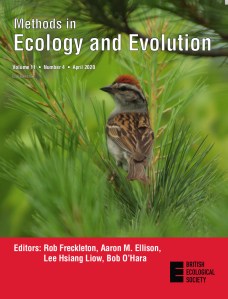
Issue 11.4: Population Dynamics, Machine Learning, Morphometrics and More

The April issue of Methods is now online!

The latest issue of Methods in Ecology and Evolution is now online! This month’s issue is a little shorter than our last few. But, as they say, good things come in small packages!

Senior Editor Lee Hsiang Liow has selected six Featured Articles this month. You can find out about all of them below. We’ve also got five Applications articles and a Practical Tools article in the April issue that we’re going to cover. Those six papers are freely available to everyone – no subscription required!

On top of all that, the April issue includes articles on camera traps, land cover classification, presence-absence sampling and more.

Continue reading “Issue 11.4: Population Dynamics, Machine Learning, Morphometrics and More”

O Problema com os ‘Fósseis Vivos’: Uma Perspectiva Filogenética Molecular

Blog escrito por: gustavo burin

This post is also available in English

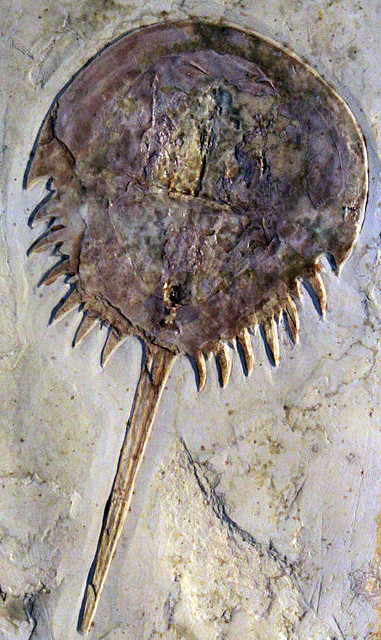
Fóssil de caranguejo-ferradura (Museu de História Natural de Berlin)

Há alguns dias, me deparei com um interessante vídeo sobre os chamados “fósseis vivos”. O vídeo focou mais nos problemas de usá-los como argumentos contra a teoria da evolução, e aproveitei a oportunidade para falar mais sobre essas linhagens longevas.

Fóssil vivo‘ é um termo usado para descrever linhagens que acredita-se terem se originado há muito tempo e que mantêm características que se assemelham a seus parentes fósseis. Alguns exemplos bem conhecidos dessas linhagens são os Tuatara da Nova Zelândia (Sphenodon punctatus) e as árvores Gingkos (Gingko biloba).

Continue reading “O Problema com os ‘Fósseis Vivos’: Uma Perspectiva Filogenética Molecular”